
mobilityDCAT-AP - Version 3.0.0

A mobility extension for the DCAT application profile for data portals in Europe

More details about this document
Latest published version:
https://w3id.org/mobilitydcat-ap/releases/
Latest editor's draft:
https://w3id.org/mobilitydcat-ap/drafts/latest/
History:
Commit history
Latest Recommendation:
https://w3id.org/mobilitydcat-ap/releases/3.0.0/
Editors:
Valentina Carriero (Cefriel)
Lina Molinas Comet (Fraunhofer Institute for Applied Information Technology FIT)
Peter Lubrich (Federal Highway and Transport Research Institute (BASt))
Julien Martineau (Nationaal Geografisch Instituut)
Daham Mohammed Mustafa (Fraunhofer Institute for Applied Information Technology FIT)
Ed Ooms (Nationaal Dataportaal Wegverkeer)
Mario Scrocca (Cefriel)
Andrej Tibaut (University of Maribor)
Author:
NAPCORE Task 4.4 (NAPCORE (National Access Point Coordination Organisation for Europe) Organization)
Feedback:
GitHub mobilityDCAT-AP/mobilityDCAT-AP (pull requests, new issue, open issues)
Document status
Completed
Document version
3.0.0
Previous version:
https://mobilitydcat-ap.github.io/mobilityDCAT-AP/releases/1.1.0/
This version:
https://mobilitydcat-ap.github.io/mobilityDCAT-AP/releases/3.0.0/

This document is also available in these non-normative formats: RDF/XML, Turtle, JSON-LD, N-Triples, SHACL shapes (Turtle), SHACL range constraints (Turtle), SHACL controlled-vocabulary constraints (Turtle), SHACL deprecated URIs (Turtle), SHACL imports (Turtle) and SHACL codelist imports (Turtle)


Abstract

mobilityDCAT-AP is a mobility-related extension of the "DCAT Application profile for data portals in Europe" ([DCAT-AP]). It allows for a structured, interoperable and harmonised way to describe and exchange metadata about data platforms and datasets with a mobility relevance. It is compatible with the parallel specifications [DCAT-AP-v3.0.1] and [GeoDCAT-AP-v3.0.0].

This document is a product of the [NAPCORE-Metadata-Working-Group].

Comments and queries should be sent via the issue tracker of the dedicated GitHub repository.

1. Introduction

1.1 Context

This document presents version 3.0.0 of the specification for mobilityDCAT-AP, a mobility-related extension of the "DCAT Application profile for data portals in Europe" ([DCAT-AP]). mobilityDCAT-AP aims to provide a structured, interoperable and harmonised approach to describing and exchanging metadata about datasets and about access for such datasets related to mobility, and in particular related to Intelligent Transport Systems (ITS). Its primary goal is to enhance the cross-border and cross-sectorial discoverability of ITS- and mobility-related datasets published on relevant data portals.

For this purpose, mobilityDCAT-AP introduces an RDF vocabulary and the corresponding RDF syntax, building upon the foundations of the original [DCAT-AP-v3.0.1] specification, while extending and customizing it for the mobility sector.

Digitalisation in the mobility domain often implies that various data assets from various actors in the mobility system are made discoverable and accessible. Accordingly, internet portals for mobility data have been developed all over the world in recent years. These portals often have specific spatial or thematic coverage, e.g., exposing public-transport timetable data for one specific region. In addition, legal obligations, such as those established through the European Union's National Access Points (NAPs, [NAPCORE-Information-about-NAPs]), mandate the creation and population of such portals.

Metadata is a crucial building block for the accessibility and reusability of datasets within NAPs and other mobility data portals. A common metadata approach can act as an important infrastructure and reference basis for providing harmonious and homogenous ITS- and mobility-related data descriptions across Europe, thus accelerating the easiness of searching, discovering, and accessing the proper data resources through the operated relevant data portals.

To serve this need, the [NAPCORE-Metadata-Working-Group] has developed a formal metadata specification called mobilityDCAT-AP.

mobilityDCAT-AP enables harmonised, platform-independent metadata descriptions in the mobility domain both in human-readable and machine-readable formats. The latter one ensures seamless integration of mobility-related platforms with third party systems by enabling the automated import and export of metadata via, for example, an API. As a specification based on the Resource Description Framework (RDF), mobilityDCAT-AP leverages semantic technologies, enabling advanced querying and inference capabilities based on metadata.

mobilityDCAT-AP provides precise and unambiguous metadata designations for any data offering with mobility relevance, e.g., to represent the data topic, the data provider or the data format. It is highly recommended that the metadata management of National Access Points (NAPs) in Europe, or any other mobility data portals, is based on mobilityDCAT-AP in order to harmonise their data descriptions and ease the exchange of metadata in the mobility data ecosystem. Furthermore, this will ensure the basis for extended interoperability, among others, with other NAPs or data portals.

mobilityDCAT-AP is compatible with the parallel specifications [DCAT-AP-v3.0.1] and [GeoDCAT-AP-v3.0.0].

This work has been carried out in the context of Task 4.4 of the [NAPCORE] project. NAPCORE is an EU-cofunded Programme Support Action under the GRANT AGREEMENT No 101234721-25-EU-TG-NAPCORE-X.

1.2 Scope description

mobilityDCAT-AP is designed as an extension of [DCAT-AP-v3.0.1] in conformance with the [DCAT-AP-Implementation-Guidelines], the [SEMIC-Style-Guide-for-Semantic-Engineers] and the [DCAT-AP-Reuse-Guidelines].

The scope description of [DCAT-AP-v3.0.1] is also valid for this version of mobilityDCAT-AP. In particular, the purpose of this specification is to facilitate data exchange. Therefore, the classes and properties defined in this document are only relevant for the data to be exchanged. There are no specific requirements for the systems involved in the data exchange process to implement particular technical environments, as long as they can export and import metadata in RDF, in conformance with mobilityDCAT-AP. Further, this specification, beyond what is defined in Conformance Statement, does not cover implementation issues such as data exchange mechanisms and the expected behavior of systems implementing mobilityDCAT-AP.

It is important to consider this dependency on the DCAT-AP specifications when reading and implementing mobilityDCAT-AP. The corresponding specifications should be consulted to address any gaps or missing information in this document.

Comparing mobilityDCAT-AP v3.0.0 to [DCAT-AP-v3.0.1], the following edits have been made:

Some of the class and property additions align with the parallel DCAT-AP extension [GeoDCAT-AP-v3.0.0], enabling compatibility between the two extensions in terms of class and property additions. All classes and property additions are marked with a prepended “plus” sign (+) in this document.

The non-usage of optional classes or properties from DCAT-AP aims to minimise the vocabulary size of mobilityDCAT-AP, avoiding any misinterpretations and multiple usage of properties among data senders.

These edits aim to capture some specific characteristics and features of mobility data, when exposed on NAPs and mobility data portals. Thus, they are meant to provide a DCAT-AP-conformant representation of metadata specific to mobility data.

1.3 Revision history

The revision history of the mobilityDCAT-AP specification is documented in the table below.

Version Date Description Action Change Log
3.0.0 19/10/2026 Major semantic release Publication I.1 Changes since [mobilityDCAT-AP-v1.1.0] (17 January 2025)
1.1.0 17/01/2025 Minor semantic release Publication I.2 Changes since mobilityDCAT-AP 1.0.1 (04 April 2024)
1.0.1 04/04/2024 Bug fix release Publication I.3 Changes since mobilityDCAT-AP 1.0.0 (16 October 2023)
1.0.0 16/10/2023 Recommendation Publication I.4 Starting point of mobilityDCAT-AP 1.0.0 (01 January 2023)
0.1 11/05/2023 First Public Working Draft Creation N/A

2. Status

This version is published as a NAPCORE Recommendation.

Information about the process and the decisions involved in the creation of this specification are consultable at the Changelog - see I. Change Log.

3. License

Copyright © 2023-2026 NAPCORE. All material in this repository is published under the license CC-BY 4.0, unless explicitly otherwise mentioned.

4. Conformance Statement

As well as sections marked as non-normative, all authoring guidelines, diagrams, examples, and notes in this specification are non-normative. Everything else in this specification is normative.

The key words MAY, MUST, RECOMMENDED, and SHOULD in this document are to be interpreted as described in BCP 14 [RFC2119] [RFC8174] when, and only when, they appear in all capitals, as shown here.

4.1 Provider requirements

In order to conform to mobilityDCAT-AP, an application that provides metadata must:

In addition to the mandatory properties, any of the optional properties defined in mobilityDCAT-AP may be provided.

All properties are specified in the sections 7. Main entities and 8. Supportive entities, and also summarised in section A. Quick Reference of Classes and Properties.

For the properties listed in the tables in section 10.2 Applied controlled vocabularies, the associated controlled vocabularies must be used according to the usage expectation of each category: a closed value space (10.2.1 Properties with controlled vocabularies that MUST be used for the listed properties), at least one value from the vocabulary with other values tolerated (10.2.2 Properties with AT LEAST 1 value from the controlled vocabularies), or a recommended use with other values tolerated (10.2.3 Properties with a RECOMMENDED use of controlled vocabularies).

4.2 Receiver requirements

In order to conform to mobilityDCAT-AP, an application that receives metadata must be able to:

To "process" means that receivers must accept incoming data and transparently provide this data to applications and services. It does neither imply nor prescribe what applications and services finally do with the data (parse, convert, store, make searchable, display to users, etc.).

5. Terminology used in mobilityDCAT-AP

5.1 RDF core definitions

mobilityDCAT-AP builds on core RDF definitions and familiarity with these concepts is assumed in this document. An introduction to the main concepts can be found in the [RDF-Primer].

5.2 SEMIC core definitions

mobilityDCAT-AP follows the terminology defined in the [SEMIC-Style-Guide-for-Semantic-Engineers]. Key concepts are reported below.

An Application Profile is a specification that reuses terms from one or more base standards, adding more specificity by identifying mandatory, recommended and optional elements to be used for a particular application, as well as recommendations for controlled vocabularies to be used. Application refers to the usage context of the specification. It may cover a data theme such as mobility data with mobilityDCAT-AP. It also may refer to specific tools like open data portals. For DCAT-AP the usage scope is broad and in the first place taking into account the European legal context.

An Extension is further specifying a given Application Profile like DCAT-AP. Many groups, who are interested in sharing Datasets related to very specific application domains, or within a certain European country, found the need to define application profiles that are more specific than DCAT-AP. As a result, there exist a number of DCAT-AP extensions (or synonymously derivatives). mobilityDCAT-AP is such an extension for the mobility domain.

5.3 mobilityDCAT-AP core definitions

Part of the following text has been reused from [DCAT-AP-v3.0.1] and the [NAPCORE-Information-about-NAPs].

A Dataset is a collection of data published or curated by a single source and available for access or download in one or more formats. In the mobility context, this might be, e.g., a data collection about static parking information for truck drivers published by a road authority. This data collection might be published in parallel in DATEX II and APDS formats.

A Data Portal is a web-based system that contains a data catalogue with descriptions of datasets and provides services enabling the discovery and re-use of the datasets.

In the context of mobility, a synonym to a data portal is a National Access Point (NAP), which is "a node in which ITS-related data are concentrated and published in the form of datasets". It is "set up to facilitate access, easy exchange and reuse of transport related data in Europe, in order to help support the provision of EU-wide interoperable travel and traffic services to end users."

A Metadata entry (or synonymously a metadata record or a metadata set) describes the administration, organisation, and content of an individual dataset, as well as the formatting and access conditions of corresponding distributions.

A Metadata registry is a digital recording or a database of all metadata entries in a data portal.

5.4 Namespaces

The namespace for mobilityDCAT-AP is: https://w3id.org/mobilitydcat-ap#

The suggested namespace prefix is: mobilitydcatap

mobilityDCAT-AP reuses terms from various existing specifications, following established best practices [DWBP]. The following table indicates the full list of corresponding namespaces used in this document.

Prefix Namespace URI Specification
adms http://www.w3.org/ns/adms# [VOCAB-ADMS]
cnt http://www.w3.org/2011/content# [CNT]
dcat http://www.w3.org/ns/dcat# [VOCAB-DCAT-3]
dcatap http://data.europa.eu/r5r/ [DCAT-AP]
dct http://purl.org/dc/terms/ [DCTERMS]
dqv http://www.w3.org/ns/dqv# [VOCAB-DQV]
eli http://data.europa.eu/eli/ontology# [ELI-Ontology]
foaf http://xmlns.com/foaf/0.1/ [FOAF]
geodcatap http://data.europa.eu/930/ [GeoDCAT-AP-v3.0.0]
locn http://www.w3.org/ns/locn# [CORE-LOCATION-VOCABULARY]
mobilitydcatap https://w3id.org/mobilitydcat-ap# current website
oa http://www.w3.org/ns/oa# [WEB-ANNOTATION-ONTOLOGY]
org http://www.w3.org/ns/org# [CORE-ORGANIZATION-ONTOLOGY]
rdf http://www.w3.org/1999/02/22-rdf-syntax-ns# [RDF11-CONCEPTS]
rdfs http://www.w3.org/2000/01/rdf-schema# [RDF-SCHEMA]
skos http://www.w3.org/2004/02/skos/core# [SKOS-REFERENCE]
vcard http://www.w3.org/2006/vcard/ns# [VCARD-RDF]
xsd http://www.w3.org/2001/XMLSchema# [XMLSCHEMA11-2]

6. Overview

6.1 mobilityDCAT-AP UML diagram

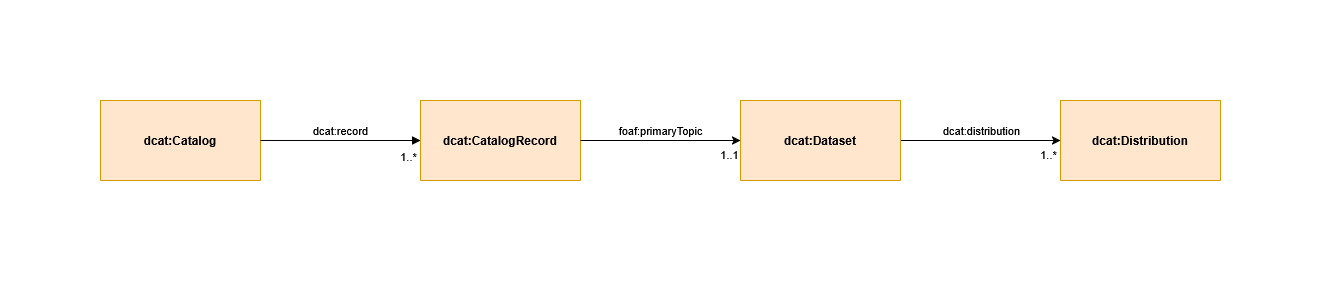
For a first orientation in mobilityDCAT-AP, these four central classes should be considered: dcat:Catalog, dcat:CatalogRecord, dcat:Dataset and dcat:Distribution; as well as the properties connecting these four classes.

Figure 1 shows an excerpt of the UML diagram of the mobilityDCAT-AP model, showing these four central classes and their connecting properties.

Excerpt of mobilityDCAT-AP UML Class Diagram with central classes
Figure 1 Excerpt of mobilityDCAT-AP UML Class Diagram with focus on central classes

These four central classes represent a hierarchical concept when describing metadata via mobilityDCAT-AP. Firstly, the Catalogue as such is described, i.e., being the metadata register in a data portal. Secondly, there is the Catalogue Record, which describes the metadata entry, including its publication date. Thirdly, the Dataset is described. In fact, most metadata elements are covered here, including the content theme; the spatial and temporal context; quality information and others. Finally, the distribution describes a technical and organisational way to access the Dataset. In addition to the data format (e.g., a machine-readable syntax standard), the licensing terms are described here.

Please note that two of the connecting properties, dcat:record and dcat:distribution, are mandatory, in contrast to [DCAT-AP-v3.0.1]. Thus, a complete metadata set in accordance with mobilityDCAT-AP should contain at least one instance of these four classes. See also the usage notes for properties dcat:record and dcat:distribution.

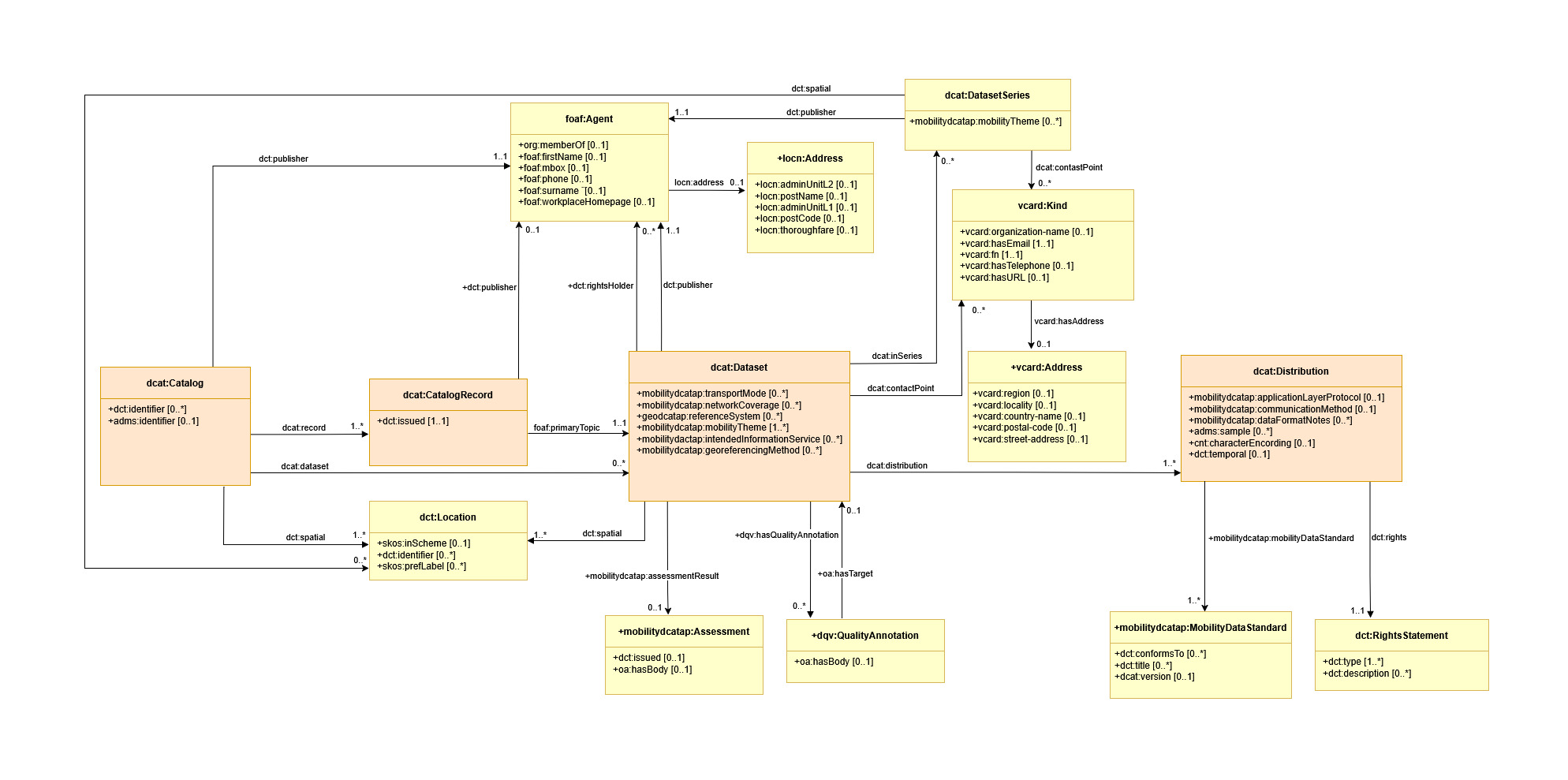
Figure 2 shows a more complex UML diagram with selected classes and properties included in mobilityDCAT-AP.

It shows the four central classes (marked in orange), as explained above, as well as some supportive classes (marked in yellow).

In this diagram, the focus is on classes and properties which have been added in mobilityDCAT-AP in comparison to [DCAT-AP-v3.0.1]. All additions are marked with a prepended “plus” sign (+).

Excerpt of mobilityDCAT-AP UML Class Diagram with focus on added classes and properties
Figure 2 Excerpt of mobilityDCAT-AP UML Class Diagram with focus on added classes and properties

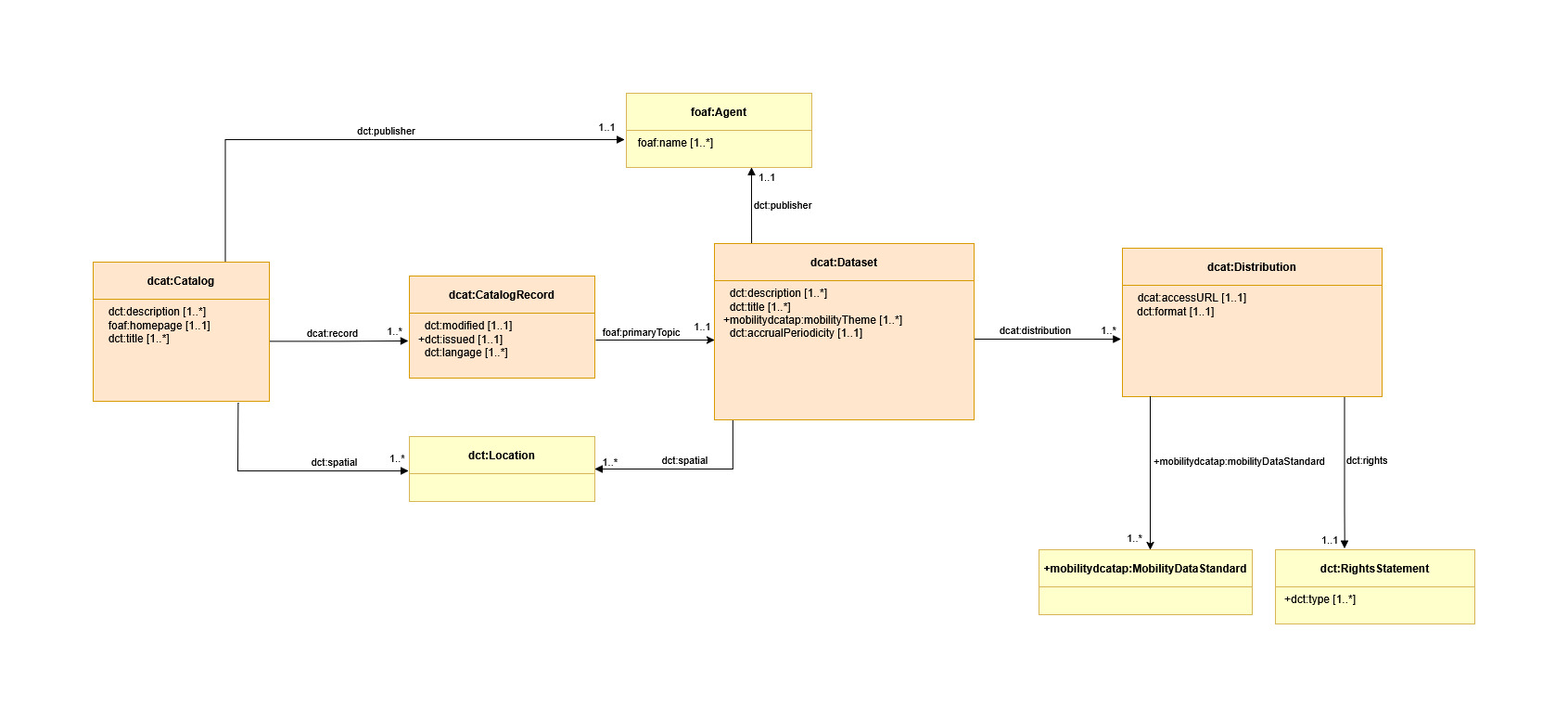
Figure 3 shows a reduced UML diagram with classes and properties that are declared mandatory in mobilityDCAT-AP.

mobilityDCAT-AP UML Minimum Class Diagram
Figure 3 Excerpt of mobilityDCAT-AP UML Class Diagram with focus on mandatory classes and properties

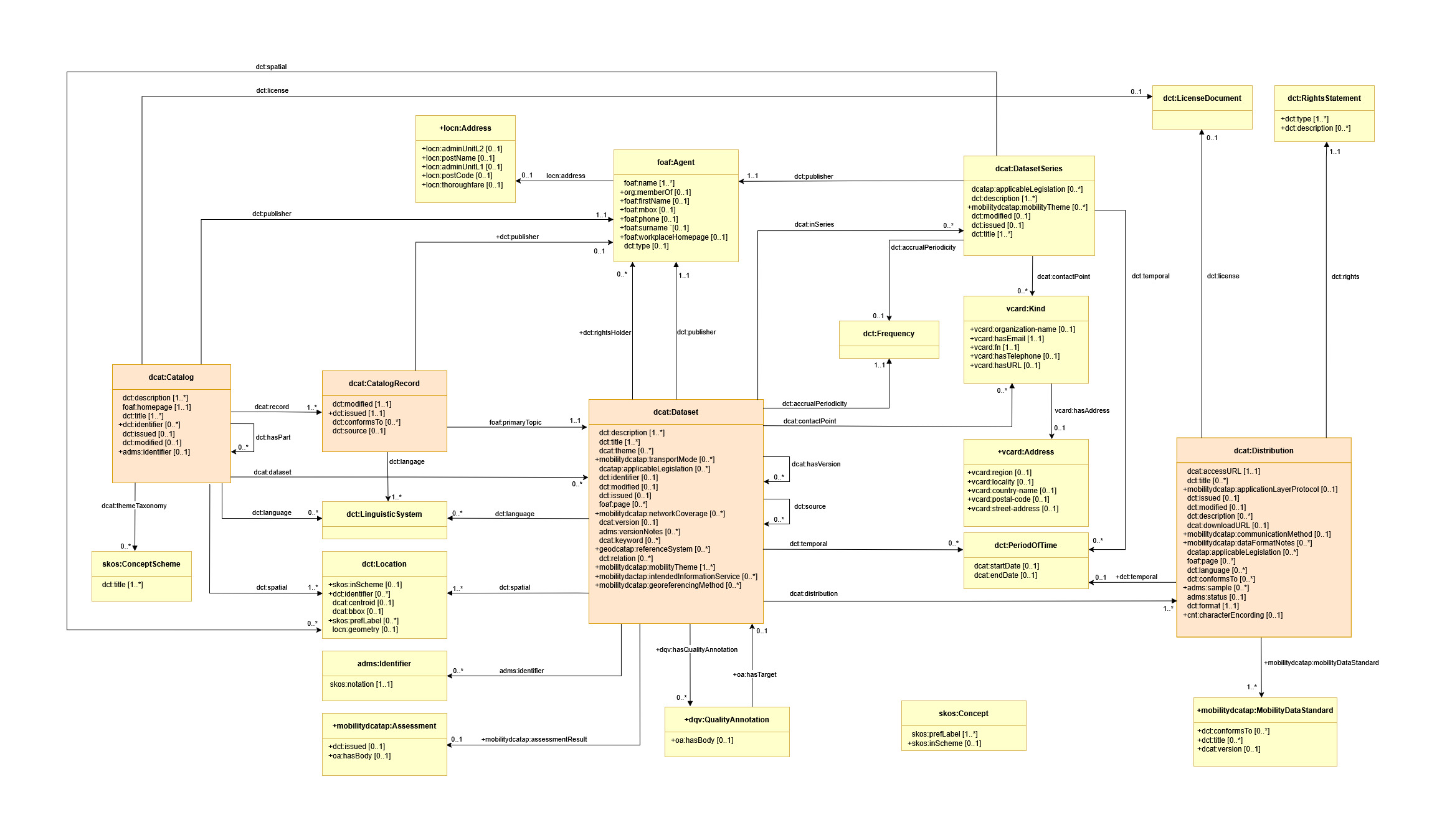
Figure 4 shows a complete UML diagram with all elements used in mobilityDCAT-AP.

mobilityDCAT-AP Complete UML Class Diagram
Figure 4 Complete mobilityDCAT-AP UML Class Diagram

7. Main entities

The main entities are those that form the core of mobilityDCAT-AP. The properties and their associated constraints that apply in the context of this profile are listed in a tabular form. Each row corresponds to one property. In addition, cross-references are provided for reused properties (i.e., their parallel definitions in [DCAT-AP-v3.0.1] and [GeoDCAT-AP-v3.0.0]), with the following abbreviations:

This reuse qualification assessment is with respect to a specific version of DCAT. Therefore it may vary over time when new versions of DCAT-AP are created.

A table of properties per class is included in A. Quick Reference of Classes and Properties.

7.1 Agent

Definition An entity (e.g., an individual or an organisation) that is associated with Catalogues, Catalogue Records, Datasets or Dataset Series.
URI

foaf:Agent

References

DCAT: Link
DCAT-AP: Link
geoDCAT-AP: Link

Usage note

According to [FOAF], an Agent may be of a type of a person (via sub-class foaf:Person), an organisation (via sub-class foaf:Organization), or a group (via sub-class foaf:Group).

For mobility data portals, it is expected that organisations are the main data actors, so the type organisation is preferred. In such case, the use of the Organization Ontology is recommended.

If a person is mentioned as an agent, he or she should be attributed to an organisation via the property org:memberOf, and, additionally, attributed with the personal name via properties foaf:firstName and foaf:surname.

The agent might be populated with the same information as for a kind, see class vcard:Kind.

When providing agent information, data publishers should prioritize organizational information over personal details. The exposure of personal information, such as a personal name and email address, may be restricted to the public. Instead, there might be an anonymous contact channel, e.g. a contact button on the GUI that triggers an email to the agent. See 12.1 Privacy and security considerations.

See also the Wiki page with more recommendations on the usage of organisational and personal information.

Properties

For this entity the following properties are defined: address, affiliation, email, first name, name, phone, surname, type, URL.

Property name and URI

Range

Card.

Definition

Usage note

Reuse

+address

locn:address

locn:Address

0..1

The postal address of the agent.

This property corresponds to an addition by [GeoDCAT-AP-v3.0.0].

GA

+affiliation

org:memberOf

org:Organization

0..1

The affiliation of the agent.

This property corresponds to an addition by [GeoDCAT-AP-v3.0.0].

GA

+email

foaf:mbox

rdfs:Resource

0..1

The email address of the agent, specified using fully qualified mailto: URI scheme RFC6068.

This property corresponds to an addition by [GeoDCAT-AP-v3.0.0].

GA

+first name

foaf:firstName

rdfs:Literal

0..1

The first name of the agent.

To be used if the agent is of type person.

P

name

foaf:name

rdfs:Literal

1..*

A name of the agent.

This property can be repeated for different versions of the name (e.g. the name in different languages) - see 11. Accessibility and Multilingual Aspects.

A

+phone

foaf:phone

rdfs:Resource

0..1

The phone number of the agent, specified using fully qualified tel: URI scheme RFC3966.

This property corresponds to an addition by [GeoDCAT-AP-v3.0.0].

GA

+surname

foaf:surname

rdfs:Literal

0..1

The surname of the agent.

To be used if the agent is of type person.

P

type

dct:type

skos:Concept

0..1

The nature of the agent.

A controlled vocabulary is provided.

E

+URL

foaf:workplaceHomepage

rdfs:Resource

0..1

The Web site of the agent.

This property corresponds to an addition by [GeoDCAT-AP-v3.0.0].

GA

7.2 +Assessment

Definition An assessment procedure by an external organisation. This organisation may be a National Body in the context of EU Delegated Regulations ([NAPCORE-Information-about-National-Bodies]). EU Delegated Regulations require Member States to set up procedures to assess the compliance with the applicable Delegated Regulations, e.g. regarding the provisioning of data via a NAP. These assessment processes are handled by National Bodies and installed individually in each Member State.
URI

mobilitydcatap:Assessment

References

DCAT: none
DCAT-AP: none
geoDCAT-AP: none

Usage note

The information is optional and needed for the documentation of the assessment procedure. It may be an internal information, only visible for assessment organisations or other authorised users.

Properties

For this entity the following properties are defined: assessment date, assessment result .

Property name and URI

Range

Card.

Definition

Usage note

Reuse

+assessment date

dct:issued

rdfs:Literal

(Datatype: Temporal Literal)

0..1

The date of the latest assessment procedure.

P

+assessment result

oa:hasBody

rdfs:Resource

0..1

The result of the latest assessment procedure, in form of a URL linking to further details or results. Alternatively, textual information is provided using the Embedded Textual Body construction of the Web Annotation Data Model, which allows to specify text formats and languages which might be relevant for multilingual purposes.

P

7.3 Catalogue

Definition A concrete mobility data portal, i.e, a web portal, where mobility-related datasets and their distributions are described via metadata and discoverable for data users.
URI

dcat:Catalog

References

DCAT: Link
DCAT-AP: Link
geoDCAT-AP: Link

Usage note
Properties

For this entity the following properties are defined: dataset, description, geographical coverage, has part, homepage, identifier, language, licence, modification date, other identifier, publisher, record, release date, themes, title .

Property name and URI

Range

Card.

Definition

Usage note

Reuse

dataset

dcat:dataset

dcat:Dataset

0..*

Links the mobility data portal with a dataset that is described at the mobility data portal.

This is a direct link from the mobility data portal to a dataset. However, in mobilityDCAT-AP, datasets should be linked indirectly, i.e., via the metadata record of this dataset. Thus, it is mandatory to use the property dcat:record to link to a data set. The usage of dcat:dataset may be then redundant.

E

description

dct:description

rdfs:Literal

1..*

A free-text account of the mobility data portal.

This property can be repeated for parallel language versions of the description - see 11. Accessibility and Multilingual Aspects.

A

geographical coverage

dct:spatial

dct:Location

1..*

A geographical area covered by the mobility data portal.

For National Access Points (NAPs), this corresponds to the EU Member State or a country that installs such NAP. The property might be used for analyses about available datasets per country, or to identify country-specific metadata in case metadata are federated from multiple national portals into an international portal. It is not to be mixed up with country codes used within the dataset property dct:spatial, which might be different.

The obligation of this property is raised to “mandatory”, comparing to [DCAT-AP-v3.0.1].

E

has part

dct:hasPart

dcat:Catalog

0..*

A related Catalogue that is part of the described mobility data portal.

May be used to link the mobility data portal to another data portal, by e.g. harvesting metadata from this other portal into the mobility data portal.

E

homepage

foaf:homepage

foaf:Document

1..1

A web page that acts as the main page for the mobility data portal.

The obligation of this property is raised to “mandatory”, comparing to [DCAT-AP-v3.0.1].

E

+identifier

dct:identifier

rdfs:Literal

0..*

The main identifier for the mobility data portal, e.g. the URI or other unique identifier. Allows a unique identification of the individual portal and is used for referencing, e.g., when exchanging metadata between mobility data portals.

This property should be populated by the URI used within the RDF statement (via rdf:about).

This property corresponds to an addition by [GeoDCAT-AP-v3.0.0].

GE

language

dct:language

dct:LinguisticSystem

0..*

Language used in the user interface of the mobility data portal, in particular the textual metadata describing the datasets registered in the portal.

This property can be repeated if the user interface and textual metadata are provided in multiple languages - see 11. Accessibility and Multilingual Aspects.

A corresponding controlled vocabulary is provided.

E

licence

dct:license

dct:LicenseDocument

0..1

A licence under which the mobility data portal can be used or reused.

A

modification date

dct:modified

rdfs:Literal

(Datatype: Temporal Literal)

0..1

The most recent date on which the mobility data portal was modified. Indicates modifications of the portal system as such (e.g., major technical updates of the portal or its features), rather than modifications of the hosted datasets, since datasets on mobility data portals are updated frequently.

E

+other identifier

adms:identifier

adms:Identifier

0..1

This property may be used as an additional identifier, besides dct:identifier.

This property may be referring to a dedicated, EU-wide identifier system of NAPs or other portals, to be introduced in the future.

This property is an addition by mobilityDCAT-AP.

P

publisher

dct:publisher

foaf:Agent

1..1

An entity (organisation) responsible for making the mobility data portal available. This organisation is the direct contact for platform users, who have questions or issues about the platform and its system.

This information should correspond to the information in the disclaimer of the platform website.

E

record

dcat:record

dcat:CatalogRecord

1..*

A metadata record that is part of the mobility data portal.

mobilityDCAT-AP assumes that metadata records are essential in mobility data portals, so the obligation of this property is raised to “mandatory”, comparing to [DCAT-AP-v3.0.1].

E

release date

dct:issued

rdfs:Literal

(Datatype: Temporal Literal)

0..1

The date of formal issuance (e.g., publication) of the mobility data portal.

E

themes

dcat:themeTaxonomy

skos:ConceptScheme

0..*

A knowledge organization system used to classify the mobility data portal's datasets.

Recommended to indicate the usage of the controlled vocabulary "Mobility Theme": <https://w3id.org/mobilitydcat-ap/mobility-theme>.

E

title

dct:title

rdfs:Literal

1..*

A name given to the mobility data portal.

This property can be repeated for parallel language versions of the name - see 11. Accessibility and Multilingual Aspects.

E

7.4 Catalogue Record

Definition A description of a metadata entry in the mobility data portal, referring to one dataset and its distributions published on the portal.
URI

dcat:CatalogRecord

References

DCAT: Link
DCAT-AP: Link
geoDCAT-AP: Link

Usage note

mobilityDCAT-AP assumes that metadata records are essential in mobility data portals, so the obligation of this class is raised to “mandatory”, comparing to [DCAT-AP-v3.0.1].

Properties

For this entity the following properties are defined: application profile, language, listing date, modification date, primary topic, publisher, source metadata .

Property name and URI

Range

Card.

Definition

Usage note

Reuse

application profile

dct:conformsTo

dct:Standard

0..*

An Application Profile that the catalogued resource's metadata conforms to. In particular, specify which mobilityDCAT-AP version is used to describe the metadata.

As the range, it is recommended to use the mobilityDCAT-AP IRI with versioning, e.g., dct:conformsTo <https://w3id.org/mobilitydcat-ap/releases/3.0.0>. The value may be generated automatically by the NAP system, corresponding to the currently used mobilityDCAT-AP version.

E

language

dct:language

dct:LinguisticSystem

1..*

The language used in the textual metadata describing titles, descriptions, etc. of the metadata entry.

The value may be generated automatically by the NAP system, corresponding to the currently used language in the user interface. Some portals offer multilingual user interfaces, e.g., in the local language and additionally in English. For multiple languages - see 11. Accessibility and Multilingual Aspects.

The obligation of this property is raised to “mandatory”, comparing to [DCAT-AP-v3.0.1].

A corresponding controlled vocabulary is provided.

E

listing date

dct:issued

rdfs:Literal

(Datatype: Temporal Literal)

1..1

The date on which the metadata entry was included in the Catalogue.

It should be generated by the system, whenever a platform user enters the metadata entry.

The obligation of this property is raised to “mandatory”, compared to [DCAT-AP-v3.0.1].

E

modification date

dct:modified

rdfs:Literal

(Datatype: Temporal Literal)

1..1

The most recent date on which the metadata entry was changed or modified.

It should be generated by the system, whenever a platform user updates the metadata entry. If there has been no update yet, the value from the property dct:issued should be taken.

E

primary topic

foaf:primaryTopic

dcat:Resource

1..1

Links the metadata entry to the dataset or dataset series described in the entry.

E

+publisher

dct:publisher

foaf:Agent

0..1

An entity (an organisation or a person), which is responsible for creation and maintenance of the metadata entry on the data platform. This entity is the direct contact for the data platform operators or data-searching users, who have questions or issues about the metadata entry.

This information can be natively created by a data platform, corresponding to the entity that is registered to the data platform and has the role of a metadata creator. This information can be also harvested from other portals. The information might be identical to the property dct:publisher of the corresponding dataset.

This property corresponds to an addition by [GeoDCAT-AP-v3.0.0].

GE

source metadata

dct:source

dcat:CatalogRecord

0..1

The original metadata record that was used in creating the metadata record.

Used for metadata records that are harvested from other portals. Harvesting, i.e., the automated import of metadata information from external portals, seems to be a common case for some NAPs. With this property, a data user can see, if the metadata was harvested, and from where. The property should link to a public URL of the dataset description on the original data portal, from where the metadata was harvested.

E

7.5 Catalogued Resource

Definition Resource published or curated by a single agent.
URI

dcat:Resource

References

DCAT: Link
DCAT-AP: Link
geoDCAT-AP: Link

Usage note This class is an abstract class. Only subclasses should be used in a data exchange, such as dcat:Dataset and dcat:DatasetSeries.
Properties

This specification does not impose any additional requirements to properties for this entity.

7.6 Dataset

Definition A dataset is a collection of data, published or curated by a single source, and available for access or download at the mobility data portal in one or more distributions. In the context of mobility-related data exchange, this might be, e.g., a data collection about static parking information for truck drivers, published by a road authority.
URI

dcat:Dataset

References

DCAT: Link
DCAT-AP: Link
geoDCAT-AP: Link

Usage note
Properties

For this entity the following properties are defined: applicable legislation, assessment result, contact point, dataset distribution, description, documentation, frequency, geographical coverage, georeferencing method, has version, identifier, in series, intended information service, keyword, language, mobility theme, modification date, network coverage, other identifier, publisher, quality description, reference system, related resource, release date, rights holder, source, temporal coverage, theme, title, transport mode, version, version notes. .

Property name and URI

Range

Card.

Definition

Usage note

Reuse

applicable legislation

dcatap:applicableLegislation

eli:LegalResource

0..*

A legal framework being relevant for the dataset, e.g., an EC Delegated Regulation which stipulates the provisioning of the corresponding dataset, or some other international or national frameworks, e.g., Open Data regulations.

E

+assessment result

mobilitydcatap:assessmentResult

mobilitydcatap:Assessment

0..1

The results and outcomes from an assessment process by an external organisation, e.g., a National Body in the context of EU Delegated Regulations. EU Delegated Regulations require Member States to set up procedures to assess the compliance of the Delegated Regulations, e.g. regarding the provisioning of data via a NAP. These assessment processes are handled by National Bodies and installed individually in each Member State.

The property may point to the most recent assessment procedure, including its date, its result as a free-text and/or a link referring to an assessment report online.

The difference to the property dqv:hasQualityAnnotation is that the latter one is provided by the data provider, while the assessment results are provided by an external organisation.

P

contact point

dcat:contactPoint

vcard:Kind

0..*

Contact information that can be used for communication with a company or person responsible for the dataset. Used for questions or issues about a dataset and its provisioning, as raised by a platform user or a platform operator.

When providing contact information, data publishers should prioritize organizational information over personal details.

The exposure of personal information, such as a personal name and email address, may be restricted to the public. Instead, there might be an anonymous contact channel, e.g. a contact button on the GUI that triggers an email to the contact point. See 12.1 Privacy and security considerations.

The contact point might be populated with the same information as for property dct:publisher.

E

dataset distribution

dcat:distribution

dcat:Distribution

1..*

An available Distribution for the Dataset.

In mobilityDCAT-AP, it is mandatory that each dataset has at least one distribution. Thus, the obligation of this property is raised to “mandatory”, compared to [DCAT-AP-v3.0.1].

E

description

dct:description

rdfs:Literal

1..*

Information about the dataset as a free-text description. It is used only for a brief overview, because free-text fields are unsuitable for searches, due to spelling mistakes, different wordings and other aspects. The categorisation and other aspects about the dataset are described within other properties of the dataset.

This property can be repeated for parallel language versions of the description - see 11. Accessibility and Multilingual Aspects. The language version should correspond to property dct:language of class Catalogue Record. I.e., if more than one language is provided as a metadata language, there should be as many language versions for the description.

E

documentation

foaf:page

foaf:Document

0..*

A page or document about this dataset.

This property is meant to link to other resources which document the dataset, e.g., PDF manuals, other websites or similar. In contrast, the property dct:description is meant to provide a textual documentation.

Please note there is also the same property foaf:page on the distribution level. Depending if the documentation is data set- or distribution-dependent, the property should be used on the data set or distribution level.

A

frequency

dct:accrualPeriodicity

dct:Frequency

1..1

Describes how often the delivered content is updated. This information tells a data consumer how often it is updated on the data platform, so the data consumer might align the frequency of data retrieval accordingly.

For dynamic data feeds, the frequency should correspond to the technical upload / data push frequency. For static datasets, it should correspond to the expected change frequency (see property dct:modified). The frequency might be a specific time interval, or a general remark such as “updated on occurrence”.

A controlled vocabulary is provided.

The obligation of this property is raised to “mandatory”, compared to [DCAT-AP-v3.0.1].

E

geographical coverage

dct:spatial

dct:Location

1..*

A geographic region that is covered by the delivered content.

The obligation of this property is raised to “mandatory”, compared to [DCAT-AP-v3.0.1].

E

+georeferencing method

mobilitydcatap:georeferencingMethod

skos:Concept

0..*

The georeferencing method used in the delivered content.

A corresponding controlled vocabulary is provided, denoting commonly used georeferencing methods for mobility data.

P

has version

dcat:hasVersion

dcat:Dataset

0..*

A related dataset that is a version, edition, or adaptation of the described dataset

It might be used to host multiple versions of the same dataset in the data portal, also enabling a version history. Multiple versions should be differentiated via the properties dcat:version and adms:versionNotes.

E

identifier

dct:identifier

rdfs:Literal

0..1

The main identifier for the dataset, e.g. the URI or other unique identifier. Allows a unique identification of the individual dataset and is used for referencing, e.g., when exchanging metadata between mobility data portals.

This property should be populated by the URI used within the RDF statement (via rdf:about).

E

in series

dcat:inSeries

dcat:DatasetSeries

0..*

A dataset series of which the dataset is part.

A

+intended information service

mobilitydcatap:intendedInformationService

skos:Concept

0..*

A type of information service, which the data content is intended to support. Such services may be, e.g., information services for multimodal mobility, as specified by [EC-Regulation-2024/490-on-MMTIS].

Examples of such services include “location search”, which is based on a datasets with address identifiers, or “trip plan computation”, which is based on datasets on timetables.

A corresponding controlled vocabulary is provided.

P

keyword

dcat:keyword

rdfs:Literal

0..*

A keyword or tag describing the Dataset.

For the purposes of mobility data portals, it is not recommended to use keywords, as they might be ambiguous, language-dependent and make data search difficult.

Instead, usage of mobility-related properties with Controlled Vocabularies is recommended, in particular mobilitydcatap:mobilityTheme, mobilitydcatap:networkCoverage and mobilitydcatap:transportMode.

If there are relevant keywords that are not part of such Controlled Vocabularies, please contact the authors of mobilityDCAT-AP, in order to update the Controlled Vocabularies.

E

language

dct:language

dct:LinguisticSystem

0..*

The language of the content data in a dataset, if this content has a natural language embedded, such as text fields, addresses etc.

This property can be repeated if there are multiple languages in the dataset - see 11. Accessibility and Multilingual Aspects

A corresponding controlled vocabulary is provided.

E

+mobility theme

mobilitydcatap:mobilityTheme

skos:Concept

1..*

This property refers to the mobility-related theme (i.e., a specific subject, category, or type) of the delivered content. A dataset may be associated with multiple themes. A theme is important for data seekers who are interested in a particular type of data content.

The theme is described via the following controlled vocabularies:

First, the mobility theme per se is described in two hierarchy levels: The 1st level is a mandatory field labelled "Data content category", describing the classification of the data content on an aggregated level. The 2nd level is an optional field labelled “Data content sub category”, detailing the "Data content category" via one or several sub-categories. When entering the metadata for one dataset, the data provider would first select one or several options of a "Data content category", and then optionally details this with one or more options of corresponding “Data content sub category”. The platform must be able to handle the dependencies between these two levels, i.e., match the allowed options between the 1st and 2nd level.

In addition, an optional controlled vocabulary "energy fuel type" specifies datasets related to the [EC-Regulation-2023/1804-on-AFIR], indicating a fuel-/energy-type covered by the dataset.

A corresponding controlled vocabulary for the Mobility Theme and controlled vocabulary for the Energy Fuel Type are provided.

This property is a sub-property of dcat:theme, being a further property of Dataset. To distinguish these two theme properties, it is recommended to label mobilitydcatap:mobilityTheme as "Mobility Theme", and dcat:theme as "EU Open Data Theme".

The subject of a dataset may also be described via property dcat:keyword. However, the usage of "mobility theme" is preferred, to avoid ambiguity and uncontrolled theme descriptions.

P

modification date

dct:modified

rdfs:Literal

(Datatype: Temporal Literal)

0..1

The most recent date on which the content of the dataset was changed or modified.

This is redundant for high-frequency data feeds (e.g., DATEX II feeds), where the change date can be derived from the time stamp within the data feed.

E

+network coverage

mobilitydcatap:networkCoverage

skos:Concept

0..*

This property describes the part of the transport network that is covered by the delivered content.

For road traffic, the property should refer to the network classification for which the data is provided. As a minimum, an international or higher-level classification, e.g., via functional road classes, is recommended to allow data search across different countries. In addition, national classifications are allowed.

For other transport modes, the property is meant to refer to the physical infrastructure which is used by the services covered by the data.

For all modes, the property should also indicate if the data content relates to the EU’s trans-European transport network.

A corresponding controlled vocabulary is provided, denoting commonly used road and infrastructure network classes.

P

other identifier

adms:identifier

adms:Identifier

0..*

This property may be used as an additional identifier, besides dct:identifier.

This property may be referring to a dedicated, EU-wide identifier system of NAP datasets, to be introduced in the future, or other identifier systems such as [DataCite-Metadata-Schema], [DOI], or [W3ID].

E

publisher

dct:publisher

foaf:Agent

1..1

An entity (company and person) that publishes the dataset. This entity is responsible for the provisioning of a dataset. The entity also concludes a contract, if applicable.

This information can be natively created by a data platform, then corresponding to the entity that is registered to the data platform and has the role of a data publisher. The information might be identical to the property dct:publisher of class Catalogue Record and/or dct:rightsHolder of class Dataset.

To establish a contact with a company or person responsible for the dataset, the property dcat:contactPoint should be used.

However, the publisher and the contact point might be populated with the same information.

The obligation of this property is raised to “mandatory”, comparing to [DCAT-AP-v3.0.1].

E

+quality description

dqv:hasQualityAnnotation

dqv:QualityAnnotation

0..*

Any quality aspects regarding the delivered content, in particular methods, metrics/indicators and results of a quality assessment. This information should assist data consumers in determining the value of data, before actually accessing and processing it. Thus, the information should be publicly available. Furthermore, it can be helpful for validation processes by 3rd parties, e.g., a National Body in context of EU Delegated Regulations.

Quality aspects should be noted via a free text and/or via URLs linking to further quality information. If there is absolutely no quality information, at least a note “quality information is unknown” should be given.

If existing quality frameworks have been applied in the quality assessment, e.g., the [NAPCORE-Quality-Frameworks], these frameworks should be referenced.

P

+reference system

geodcatap:referenceSystem

skos:Concept

0..*

The spatial reference system used in the delivered content. To be specified via the “EPSG coordinate reference systems” register operated by OGC.

A corresponding controlled vocabulary is provided.

This is a sub-property of dct:conformsTo.

This property corresponds to an addition by [GeoDCAT-AP-v3.0.0].

GA

release date

dct:issued

rdfs:Literal

(Datatype: Temporal Literal)

0..1

The date of formal issuance (e.g., publication) of the dataset.

There might be a difference in the listing date of the metadata entry; see the property dct:issued of class Catalogue Record. Imagine the dataset is published outside the mobility data portal first, and afterwards published as a metadata entry on the portal, leading to two different dates. However, both dates can also be the same.

E

+rights holder

dct:rightsHolder

foaf:Agent

0..*

An entity that legally owns or holds the rights of the data provided in a dataset. This entity is legally responsible for the content of the data and (if applicable) for the relevance to legal frameworks (see property dcatap:applicableLegislation).

The rights holder will be in many cases identical with the publisher of the dataset (see property dct:publisher) and/or of the catalogue record (see property dct:publisher). In such case, the rights holder data may be copied from the corresponding publisher entries. There might be also cases with non-identical entities: e.g., when one or several rights holders contract a third-party publisher (e.g., an IT service company), which is producing, hosting and publishing a dataset.

This property corresponds to an addition by [GeoDCAT-AP-v3.0.0].

GE

source

dct:source

dcat:Dataset

0..*

A related Dataset from which the described Dataset is derived.

There is the same property dct:source on the Catalogue Record level. The source of a dataset relates to the content data, whereas the source of a catalogue record relates to the metadata.

E

temporal coverage

dct:temporal

dct:PeriodOfTime

0..*

A temporal period, i.e., the beginning and the end, of the time reference of the delivered content (e.g., validity time of a public-transport time table).

E

theme

dcat:theme

skos:Concept

0..*

The generic theme (i.e., a specific subject, category, or type) of the content of the dataset.

A controlled vocabulary is provided.

E

title

dct:title

rdfs:Literal

1..*

The name given to the dataset in a generic term. The name should be a meaningful, unique and unambiguous label.

This property can be repeated for parallel language versions of the title - see 11. Accessibility and Multilingual Aspects. The language version should correspond to property dct:language of class Catalogue Record. I.e., if more than one language is provided as a metadata language, there should be as many language versions for the title.

E

+transport mode

mobilitydcatap:transportMode

skos:Concept

0..*

The transport mode that is covered by the delivered content.

It is described via the following controlled vocabularies:

First, the transport mode per se is described in a narrower sense, with a focus on the physical means of transport (car, bus, etc.).

In addition, an optional controlled vocabulary "mobility service" specifies datasets, which cover transport modes with specific mobility services (e.g., sharing, hiring, transport, etc.).

A corresponding controlled vocabulary for the Transport Mode and controlled vocabulary for the Mobility or Transport Service are provided.

P

version

dcat:version

rdfs:Literal

0..1

The version indicator (name or identifier) of a dataset.

The version number should be updated, whenever there are changes to the dataset noted by the property dct:modified.

Together with property adms:versionNotes, this may also enable a change history (or version history) of the corresponding dataset, which could be hosted and published on the data platform.

E

version notes

adms:versionNotes

rdfs:Literal

0..*

A textual description of the differences between this version and a previous version of the dataset.

This property should be an addition to the property dcat:version.

This property can be repeated for parallel language versions of the version notes - see 11. Accessibility and Multilingual Aspects.

E

7.7 Dataset Series

Definition A collection of datasets that are published separately, but share some characteristics that group them.
URI

dcat:DatasetSeries

References

DCAT: Link
DCAT-AP: Link
geoDCAT-AP: Link

Usage note

It is recommended to avoid Dataset Series without a dataset in the collection. Therefore at least one Dataset should refer to a Dataset Series using the property in series (dcat:inSeries).

Further instructions on the usage of Dataset Series are given in the Wiki page on Dataset Series, the [DCAT-AP-v3.0.1-Usage-guide-on-Dataset-Series] and the [DCAT-AP-v3.0.1-Examples-for-Dataset-Series].

Properties

For this entity the following properties are defined: applicable legislation, contact point, description, frequency, geographical coverage, mobility theme, modification date, publisher, release date, temporal coverage, title .

Property name and URI

Range

Card.

Definition

Usage note

Reuse

applicable legislation

dcatap:applicableLegislation

eli:LegalResource

0..*

A legal framework being relevant for the dataset series.

E

contact point

dcat:contactPoint

vcard:Kind

0..*

Contact information that can be used for communication with a company or person responsible for the dataset series. Used for questions or issues about a dataset series and its provisioning, as raised by a platform user or a platform operator.

When providing contact information, data publishers SHOULD prioritize organizational information over personal details.

The exposure of personal information, such as a personal name and email address, may be restricted to the public. Instead, there might be an anonymous contact channel, e.g. a contact button on the GUI that triggers an email to the contact point. See 12.1 Privacy and security considerations.

E

description

dct:description

rdfs:Literal

1..*

Information about the dataset series as a free-text description.

It is recommended to provide an indication about the dimensions the Dataset Series evolves, e.g., if it evolves according to the time, geolocation or other dimensions.

This property can be repeated for parallel language versions of the description - see 11. Accessibility and Multilingual Aspects. The language version should correspond to property dct:language of class Catalogue Record. I.e., if more than one language is provided as a metadata language, there should be as many language versions for the description.

E

frequency

dct:accrualPeriodicity

dct:Frequency

0..1

Describes how often the dataset series is updated.

The frequency of a dataset series is understood differently to the frequency of the dataset in the series, as declared via property dct:accrualPeriodicity.

See the examples no. 5 and 6 in the [DCAT-AP-v3.0.1-Examples-for-Dataset-Series].

A controlled vocabulary is provided.

A

geographical coverage

dct:spatial

dct:Location

0..*

A geographic region that is covered by the dataset series.

When spatial coverage is a dimension in the dataset series then the spatial coverage of each dataset in the series should be part of the spatial coverage of the dataset series. In that case, the value of the spatial coverage of the dataset series should be as wide as possible. E.g., if datasets in a series are about different regions in a country, the spatial coverage of the dataset series should note the entire country. See also the examples no. 7 and 8 in the [DCAT-AP-v3.0.1-Examples-for-Dataset-Series].

E

+mobility theme

mobilitydcatap:mobilityTheme

skos:Concept

0..*

This property refers to the mobility-related theme (i.e., a specific subject, category, or type) of the dataset series. See the definition of property with the same name mobilitydcatap:mobilityTheme of class Dataset. It is recommended that the theme does not change among datasets in the series, i.e., the theme of the dataset series should be equal to the theme of each dataset in the series.

Corresponding controlled vocabularies are provided as for mobilitydcatap:mobilityTheme of class Dataset.

P

modification date

dct:modified

rdfs:Literal

(Datatype: Temporal Literal)

0..1

The most recent date on which the dataset series was changed or modified.

This should correspond to the most recent modification date of all datasets in the series, as declared via property dct:modified.

See also the example no. 11 in the [DCAT-AP-v3.0.1-Examples-for-Dataset-Series].

E

publisher

dct:publisher

foaf:Agent

0..1

An entity (company and person) that publishes the dataset series. This entity is also responsible for ensuring the coherency of the dataset series.

The publisher of the dataset series may be (but does not need to be) the publisher of datasets in the series, as declared via property dct:publisher. An example for a case where the publisher is different from the publisher of datasets in the series: a digital archive could take over the publishing of older datasets in the series.

E

release date

dct:issued

rdfs:Literal

(Datatype: Temporal Literal)

0..1

The date of formal issuance (e.g., publication) of the dataset series.

The moment when the dataset series was established as a managed resource. This might correspond to the earliest release date of the dataset in the series, as declared via property dct:issued. See also the examples no. 9 and 10 in the [DCAT-AP-v3.0.1-Examples-for-Dataset-Series].

E

temporal coverage

dct:temporal

dct:PeriodOfTime

0..*

A temporal period, i.e., the beginning and the end, of the time reference that the Dataset Series covers.

When temporal coverage is a dimension in the dataset series then the temporal coverage of each dataset in the series should be part of the temporal coverage. In that case, an open ended value is recommended, e.g. "after 2012".

E

title

dct:title

rdfs:Literal

1..*

The name given to the dataset series in a generic term. The name should be a meaningful, unique and unambiguous label.

This property can be repeated for parallel language versions of the title - see 11. Accessibility and Multilingual Aspects.

E

7.8 Distribution

Definition A distribution describes the data formats and communication methods for a dataset. There may be one or multiple distributions for one dataset. For example, the same dataset (e.g. static parking information for truck drivers) can be provided in different ways e.g. as downloadable zip file or as XML using a REST web service. These are two distributions based on one dataset.
URI

dcat:Distribution

References

DCAT: Link
DCAT-AP: Link
geoDCAT-AP: Link

Usage note

For the context of mobility data portals, it can be expected that all datasets have one or more distributions. Thus, there must be at least one instance of class Distribution related to one dataset. This is in contrast to [DCAT-AP-v3.0.1], which allows for datasets without distributions.

Properties

For this entity the following properties are defined: access url, application layer protocol, applicable legislation, character encoding, communication method, data format notes, description, documentation, download url, format, language, licence, linked schemas, mobility data standard, modification date, release date, rights, sample, status, temporal coverage, title.

Property name and URI

Range

Card.

Definition

Usage note

Reuse

access url

dcat:accessURL

rdfs:Resource

1..1

A URL that gives access to a distribution of the dataset.

Depending on the type of data provision, there are different options for describing the URL.

If the data is accessed via an API, the URL should be the end point of such API.

If some agreements between the data provider and the data user need to be established first, the access URL should link to web page, where the access is further arranged, e.g., initiating a subscription process.

For data which can be downloaded directly, the download URL should be copied from the property dcat:downloadURL.

For other cases, where data cannot be directly accessed or downloaded via the platform, the access URL may be a link to an external service or a website which enables access to the data.

E

+application layer protocol

mobilitydcatap:applicationLayerProtocol

skos:Concept

0..1

The transmitting channel, i.e., the Application Layer Protocol, of the distribution.

A corresponding controlled vocabulary is provided.

P

applicable legislation

dcatap:applicableLegislation

eli:LegalResource

0..*

A legal framework being relevant for the distribution.

The legal framework is usually provided on the dataset level, see property dcatap:applicableLegislation. However, there is a special case of if a High Value Dataset (HVD) is provided. Here, the [DCAT-AP-High-Value-Datasets] specification stipulates that this property links to the [EC-Regulation-2023/138-on-HVD] both on the dataset and distribution levels. In other words, a RDF statement is required under the dataset and distribution class, if a HVD is published on the portal. For other cases outside HVD, the use of this property is not recommended.

E

+character encoding

cnt:characterEncoding

rdfs:Literal

0..1

The technical encoding format of the delivered content within the distribution.

It should be expressed using a character set name defined in the [IANA-CHARACTER-SETS] register.

This property is analogue to an addition by [GeoDCAT-AP-v3.0.0].

GE

+communication method

mobilitydcatap:communicationMethod

skos:Concept

0..1

Indicates for dynamically provided distributions, e.g., data feeds, if the data interface of the data provider system functions in a push or pull mode.

A corresponding controlled vocabulary is provided.

P

+data format notes

mobilitydcatap:dataFormatNotes

rdfs:Literal

0..*

Any additional information about the format of the delivered content within the distribution in a textual format.

This property can be repeated for parallel language versions of the data format notes - see 11. Accessibility and Multilingual Aspects.

P

description

dct:description

rdfs:Literal

0..*

A free-text account of the Distribution.

This property can be repeated for parallel language versions of the description - see 11. Accessibility and Multilingual Aspects.

E

documentation

foaf:page

foaf:Document

0..*

A page or document about the distribution.

This property is meant to link to other resources which document the data distribution, e.g., PDF manuals, other websites or similar. In contrast, the property dct:description is meant to provide a textual documentation.

Please note there is also the same property foaf:page on the dataset level. Depending if the documentation is data set- or distribution-dependent, the property should be used on the data set or distribution level.

A

download url

dcat:downloadURL

rdfs:Resource

0..1

A URL that is a direct link to a downloadable file in a given format.

A

format

dct:format

dct:MediaTypeOrExtent

1..1

The technical syntax of the delivered content within the distribution. It describes the base standard that specifies syntactically correct documents. On this level, base elements are properly specified on how to build a document. The resulting document can then be validated by syntax checks.

A controlled vocabulary is provided.

The obligation of this property is raised to “mandatory”, compared to [DCAT-AP-v3.0.1].

There is a similar property in [DCAT-AP-v3.0.1] called dcat:mediaType. This one is not used in mobilityDCAT-AP. The reason is the use of controlled vocabularies: dct:format uses the EU Authority List about file types ([EUV-FT]), whereas dcat:mediaType uses the [IANA-Media-Types] register. The first one, however, is sufficient to describe the syntaxes commonly used in mobility data portals.

E

language

dct:language

dct:LinguisticSystem

0..*

The language of the content data in a distribution, if this content has a natural language embedded, such as text fields, addresses etc.

There is the same property dct:language under class Dataset. Language information on the distribution level is only recommended, if there are multiple distributions for the same dataset with a different language each.

A corresponding controlled vocabulary is provided.

This property can be repeated if there are multiple languages in the distribution - see 11. Accessibility and Multilingual Aspects.

E

licence

dct:license

dct:LicenseDocument

0..1

The licence under which the distribution is made available. This should be a reference to a concrete (standard) licence.

A controlled vocabulary is provided.

E

linked schemas

dct:conformsTo

dct:Standard

0..*

An established schema to which the described Distribution conforms.

To inform about a mobility data standard (and also related profiles) applied to the delivered data, property mobilitydcatap:mobilityDataStandard should be preferably used. In addition, property dct:conformsTo can be used to serve the needs of standard DCAT/DCAT‑AP open data portals. Such portals usually cannot process information exposed indirectly via property mobilitydcatap:mobilityDataStandard, i.e., they cannot dereference or validate such references. Thus, this property would expose the standards/profiles information directly at the Distribution.

E

+mobility data standard

mobilitydcatap:mobilityDataStandard

mobilitydcatap:MobilityDataStandard

1..*

The mobility data standard, as applied for the delivered content within the distribution. A mobility data standard, e.g., DATEX II, combines syntax and semantic definitions of entities in a certain domain (e.g., for DATEX II: road traffic information), and optionally adds technical rules for data exchange.

This is a sub-property of dct:conformsTo.

A corresponding controlled vocabulary is provided, listing common mobility data standards. At least one value from this controlled vocabulary is required. If no suitable standard is found in this vocabulary, the "other" entry should be used.

Optionally, a new individual instance of class mobilitydcatap:MobilityDataStandard can be provided. This instance might be used to (a) reference a mobility data standard that is not listed in the controlled vocabulary; or (b) provide additional information on an applied mobility data standard (even if listed in the controlled vocabulary), such as version or schema details. See the Wiki page for a code example with a reference to a mobility data standard (listed in the controlled vocabulary), and detailed information via an individual instance of class mobilitydcatap:MobilityDataStandard.

P

modification date

dct:modified

rdfs:Literal

(Datatype: Temporal Literal)

0..1

The most recent date on which the Distribution was changed or modified.

There is the same property dct:modified under the Dataset level. Under the distribution level, this property describes temporal changes in the characteristics of a distribution, e.g., a new data format or similar.

E

release date

dct:issued

rdfs:Literal

(Datatype: Temporal Literal)

0..1

The date of formal issuance (e.g., publication) of the Distribution.

There is the same property dct:issued at the Dataset level. Under the distribution level, this property relates to the release time of a distribution, which might be different than the release time of a dataset.

E

rights

dct:rights

dct:RightsStatement

1..*

A statement that specifies rights associated with the distribution. In particular, a statement about the intellectual property rights (IPR). As a minimum, it should include an information on the type of conditions for access and usage.

A concrete (standard) license can be referred via the recommended property dct:license.

The obligation of this property is raised to “mandatory”, compared to [DCAT-AP-v3.0.1].

E

+sample

adms:sample

rdfs:Resource

0..*

A sample of the delivered content, using the same conditions (e.g., the same format and licence) as the regular distribution. A sample allows data users to investigate the data content and data structure, without subscribing to a data feed or downloading a complete data set.

In [DCAT-AP-v3.0.1], there is a property adms:sample under class Dataset, with class Distribution as the range. This implies that all mandatory properties for a distribution, e.g., the applied Mobility Data Standard, must be applied for a sample. To simplify the description of the sample, mobilityDCAT-AP recommends to describe the sample via a property under class Distribution, instead under class Dataset.

P

status

adms:status

skos:Concept

0..1

The status of the distribution in the context of maturity lifecycle.

It must take one of the values Completed, Deprecated, Under Development, Withdrawn. A corresponding controlled vocabulary is provided.

A

+temporal coverage

dct:temporal

dct:PeriodOfTime

0..1

The time interval when a distribution is facilitated (i.e., activated) technically via the data platform. Might be used if data access via a distribution is limited in time.

If there is no entry it means that the distribution has no explicit start time (i.e., it is facilitated immediately) and has no end time (i.e., it is facilitated infinitely).

P

title

dct:title

rdfs:Literal

0..*

A name given to the distribution.

This property can be repeated for parallel language versions of the title - see 11. Accessibility and Multilingual Aspects.

E

7.9 Kind

Definition A description following the [VCARD-RDF], e.g., to provide telephone number and e-mail address for a contact point.
URI

vcard:Kind

References

DCAT: none
DCAT-AP: Link
geoDCAT-AP: Link

Usage note

This class is the parent class for the four explicit types of vCards (vcard:Individual, vcard:Organization, vcard:Location, vcard:Group).

The contact point might be populated with the same information as for an agent, see class foaf:Agent.

When providing contact information, data publishers SHOULD prioritize organizational information over personal details. The exposure of personal information, such as a personal name and email address, may be restricted to the public. Instead, there might be an anonymous contact channel, e.g. a contact button on the GUI that triggers an email to the agent. See 12.1 Privacy and security considerations.

Properties

For this entity the following properties are defined: address, affiliation, email, name, phone, URL .

Property name and URI

Range

Card.

Definition

Usage note

Reuse

+address

vcard:hasAddress

vcard:Address

0..1

The postal address of the kind, i.e., of an individual, an organization, a location or a group.

This property corresponds to an addition by [GeoDCAT-AP-v3.0.0].

GA

+affiliation

vcard:organization-name

rdfs:Literal

0..1

The affiliation of the kind, i.e., of an individual, an organization, a location or a group.

This property corresponds to an addition by [GeoDCAT-AP-v3.0.0].

GA

+email

vcard:hasEmail

vcard:Email

1..1

The email address of the kind (i.e., an individual, an organization, a location or a group), specified using fully qualified mailto: URI scheme RFC6068.

This property corresponds to an addition by [GeoDCAT-AP-v3.0.0], however, with a raised obligation level.

GE

+name

vcard:fn

rdfs:Literal

1..1

A name of the kind, i.e., a unique name of an individual, an organization, a location or a group.

This property corresponds to an addition by [GeoDCAT-AP-v3.0.0], however, with a raised obligation level.

GE

+phone

vcard:hasTelephone

rdfs:Resource

0..1

The phone number of the kind (i.e., an individual, an organization, a location or a group), specified using fully qualified tel: URI scheme RFC3966.

This property corresponds to an addition by [GeoDCAT-AP-v3.0.0].

GA

+URL

vcard:hasURL

rdfs:Resource

0..1

A web site of the kind., i.e., of an individual, an organization, a location or a group.

This property corresponds to an addition by [GeoDCAT-AP-v3.0.0].

GA

7.10 License Document

Definition A legal document, e.g., a concrete license, giving official permission to do something with a resource.
URI

dct:LicenseDocument

References

DCAT: none
DCAT-AP: Link
geoDCAT-AP: Link

Usage note

This class is used to reference an applicable (standard) licence via an IRI, so a data user can assess the license conditions in machine- and human-readable formats, before using the data.

Via an instance of this class, a reference to a standard or a organisation-specific license can be given. For standard licenses, a Controlled Vocabulary is provided.

See the Wiki page on Rights and Licenses for further guidance.

Properties

This specification does not impose any additional requirements to properties for this entity.

7.11 Location

Definition A spatial region or named place.
URI

dct:Location

References

DCAT: none
DCAT-AP: Link
geoDCAT-AP: Link

Usage note

It can be represented via a geocode (= a named place) or with geographic coordinates, according to DCAT-AP guidelines [DCAT-AP-guideline-spatial].

For mobility data portals, usage of geocodes is preferred. Many mobility data providers represent public authorities such as states, regions, municipalities etc, which can be easily represented via named places. In contrast, defining of coordinates per dataset might be error-prone and inconsistent.

As geocodes, IRIs from predefined controlled vocabularies such as the EU authority tables, NUTS (Nomenclature des unités territoriales statistiques) or Geonames.org should be used.

These IRIs can be linked directly from class dct:Location, or indirectly via custom instances of class dct:Location, from the dct:identifier property of this class.

See the Wiki page on Geographical coverage​ for more guidance and code examples on how to use the class dct:Location.

Properties

For this entity the following properties are defined: bounding box, centroid, gazetteer, geographic identifier, geographic name, geometry .

Property name and URI

Range

Card.

Definition

Usage note

Reuse

bounding box

dcat:bbox

rdfs:Literal

0..1

The geographic bounding box of the location.

A

centroid

dcat:centroid

rdfs:Literal

0..1

The geographic center (centroid) of the location.

A

+gazetteer

skos:inScheme

skos:ConceptScheme

0..1

The gazetteer, i.e., a codelist to which the location belongs.

This property corresponds to an addition by [GeoDCAT-AP-v3.0.0].

GA

+geographic identifier

dct:identifier

rdfs:Literal

0..*

This property contains the geographic identifier for the location, e.g., the URI or other unique identifier in the context of the relevant gazetteer.

Corresponding controlled vocabularies are provided, denoting commonly used geographic identifiers.

This property corresponds to an addition by [GeoDCAT-AP-v3.0.0].

GA

+geographic name

skos:prefLabel

rdfs:Literal

0..*

A preferred label of the location.

This property can be repeated for parallel language versions of the label - see 11. Accessibility and Multilingual Aspects.

This property corresponds to an addition by [GeoDCAT-AP-v3.0.0].

GA

geometry

locn:geometry

locn:Geometry

0..1

The corresponding geometry for the location.

A

7.12 +Mobility Data Standard

Definition The mobility data standard applied for the delivered content. A mobility data standard, e.g., DATEX II, combines syntax and semantic definitions of entities in a certain domain (e.g., for DATEX II: road traffic information), and optionally adds technical rules for data exchange.
URI

mobilitydcatap:MobilityDataStandard

References

DCAT: none
DCAT-AP: none
geoDCAT-AP: none

Subclass of

dct:Standard.

Usage note

Further instructions on the usage of Mobility Data Standard are given in the Wiki page on Mobility Data Standard.

Properties

For this entity the following properties are defined: conforms to, title, version .

Property name and URI

Range

Card.

Definition

Usage note

Reuse

+conforms to

dct:conformsTo

dct:Standard

0..*

Reference to the applied mobility data standard, as well as to individual/national/content-specific profiles or representations of the applied standard.

This property is necessary if a custom instance of class mobilitydcatap:MobilityDataStandard is defined. This property would then reference a common mobility data standard (e.g., "NeTeX" via the controlled vocabulary), as well as additionally further individual/national/content-specific profiles or representations of the applied standard (e.g., an Italian NeTEx profile).

P

+title

dct:title

rdfs:Literal

0..*

A name given to the mobility data standard.

This property can be repeated for parallel language versions of the title - see 11. Accessibility and Multilingual Aspects.

P

+version

dcat:version

rdfs:Literal

0..1

The version of the mobility data standard, as applied within the delivered content. A version might be, e.g., DATEX II v3.2.

This information is provided in a textual format. To avoid ambiguity, only short version identifiers should be used, e.g., "3.2", without redundant acronyms such as "v", underscores etc.

P

7.13 +Quality Annotation

Definition An annotation about any quality aspects regarding the delivered content, in particular methods, metrics/indicators and results of a quality assessment in the responsibility of the Data Owner.
URI

dqv:QualityAnnotation

References

DCAT: none
DCAT-AP: none
geoDCAT-AP: none

Usage note

There is a similar class dqv:Quality Measurement in [GeoDCAT-AP-v3.0.0]. Both dqv:QualityAnnotation and dqv:Quality Measurement are reusing the [VOCAB-DQV]. dqv:Quality Measurement is referring to concrete metrics, like sub-types of spatial resolutions being used in GeoDCAT-AP. At mobility data portals, however, the practice so far is to provide a more generic quality description, e.g., via a free-text report. Thus, dqv:QualityAnnotation refers to an unspecified form of quality annotation.

Properties

For this entity the following properties are defined: quality annotation resource.

Property name and URI

Range

Card.

Definition

Usage note

Reuse

+quality annotation resource

oa:hasBody

rdfs:Resource

0..1

Any quality aspects regarding the delivered content, in form of a URL linking to further details or results, or textual information.

Textual information should be provided using the Embedded Textual Body construction of the [Web-Annotation-Data-Model], which allows to specify text formats and languages which might be relevant for multilingual purposes.

P

8. Supportive entities

The supportive entities are supporting the main entities in mobilityDCAT-AP. They are included because they form the range of properties.

8.1 +Address (Core Location)

Definition A postal address used for agent information.
URI

locn:Address

References

DCAT: none
DCAT-AP: none
geoDCAT-AP: Link

Usage note

See the definition of the Address entity in the [CORE-LOCATION-VOCABULARY].

This class corresponds to an addition by [GeoDCAT-AP-v3.0.0].

Properties

For this entity the following properties are defined: administrative area, city, country, postal code, street address.

Property

URI

Range

Card.

Definition

Usage note

Reuse

+administrative area

locn:adminUnitL2

rdfs:Literal

0..1

The administrative area of an address. Depending on the country, this corresponds to a province, a county, a region, or a state.

This property corresponds to an addition by [GeoDCAT-AP-v3.0.0].

GE

+city

locn:postName

rdfs:Literal

0..1

The name of the city of the address.

This property corresponds to an addition by [GeoDCAT-AP-v3.0.0].

GE

+country

locn:adminUnitL1

rdfs:Literal

0..1

The country of an address.

This property corresponds to an addition by [GeoDCAT-AP-v3.0.0].

GE

+postal code

locn:postCode

rdfs:Literal

0..1

The postal code of an address.

This property corresponds to an addition by [GeoDCAT-AP-v3.0.0].

GE

+street address

locn:thoroughfare

rdfs:Literal

0..1

The street name and civic number of the address.

This property corresponds to an addition by [GeoDCAT-AP-v3.0.0].

GE

8.2 +Address (vCard)

Definition A postal address used for contact point information.
URI

vcard:Address

References

DCAT: none
DCAT-AP: none
geoDCAT-AP: Link

Usage note

This class corresponds to an addition by [GeoDCAT-AP-v3.0.0].

Properties

For this entity the following properties are defined: administrative area, city, country, postal code, street address.

Property

URI

Range

Card.

Definition

Usage note

Reuse

+administrative area

vcard:region

rdfs:Literal

0..1

The administrative area of an address. Depending on the country, this corresponds to a province, a county, a region, or a state.

This property corresponds to an addition by [GeoDCAT-AP-v3.0.0].

GA

+city

vcard:locality

rdfs:Literal

0..1

The name of the city of the address.

This property corresponds to an addition by [GeoDCAT-AP-v3.0.0].

GA

+country

vcard:country-name

rdfs:Literal

0..1

The country of an address.

This property corresponds to an addition by [GeoDCAT-AP-v3.0.0].

GA

+postal code

vcard:postal-code

rdfs:Literal

0..1

The postal code of an address.

This property corresponds to an addition by [GeoDCAT-AP-v3.0.0].

GA

+street address

vcard:street-address

rdfs:Literal

0..1

The street name and civic number of the address.

This property corresponds to an addition by [GeoDCAT-AP-v3.0.0].

GA

8.3 Concept

Definition An idea or notion; a unit of thought.
URI

skos:Concept

References

DCAT: none
DCAT-AP: Link
geoDCAT-AP: Link

Usage note

A Concept is used to denote codes within a codelist.

In mobilityDCAT-AP, this property is used to denote a specific value from a controlled vocabulary, see 10. Controlled Vocabularies.

Properties

For this entity the following properties are defined: preferred label, concept scheme .

Property name and URI

Range

Card.

Definition

Usage note

Reuse

preferred label

skos:prefLabel

rdfs:Literal

1..*

A preferred label of the concept.

This property can be repeated for parallel language versions of the label - see 11. Accessibility and Multilingual Aspects.

A

+concept scheme

skos:inScheme

skos:ConceptScheme

0..1

Relates a concept to a concept scheme in which it is included.

This property corresponds to an addition by [GeoDCAT-AP-v3.0.0].

GE

8.4 Concept Scheme

Definition An aggregation of one or more SKOS concepts, see class skos:Concept. Semantic relationships (links) between those concepts may also be viewed as part of a concept scheme.
URI

skos:ConceptScheme

References

DCAT: none
DCAT-AP: Link
geoDCAT-AP: Link

Usage note

A Concept Scheme is used to denote a codelist.

In mobilityDCAT-AP, this property is used to denote a specific controlled vocabulary, see 10. Controlled Vocabularies.

Properties

For this entity the following properties are defined: title .

Property name and URI

Range

Card.

Definition

Usage note

Reuse

title

dct:title

rdfs:Literal

1..*

A name of the concept scheme.

This property can be repeated for parallel language versions of the name - see 11. Accessibility and Multilingual Aspects.

A

8.5 Document

Definition A textual resource intended for human consumption that contains information, e.g. a web page about a Dataset.
URI

foaf:Document

References

DCAT: none
DCAT-AP: Link
geoDCAT-AP: Link

Usage note

N/A

Properties

This specification does not impose any additional requirements to properties for this entity.

8.6 +Email (vCard)

Definition The electronic mail address for communication with the object.
URI

vcard:Email

References

DCAT: none
DCAT-AP: none
geoDCAT-AP: Link

Usage note

See the definition of class vcard:Email in the [VCARD-RDF].

This class corresponds to an addition by [GeoDCAT-AP-v3.0.0].

Properties

This specification does not impose any additional requirements to properties for this entity.

8.7 Frequency

Definition A rate at which something recurs, e.g., the update rate of a dataset.
URI

dct:Frequency

References

DCAT: none
DCAT-AP: Link
geoDCAT-AP: Link

Usage note

none

Properties

This specification does not impose any additional requirements to properties for this entity.

8.8 Geometry

Definition The means to identify a location as a point, line, polygon, etc. expressed using coordinates in some coordinate reference system.
URI

locn:Geometry

References

DCAT: none
DCAT-AP: Link
geoDCAT-AP: Link

Usage note

none

Properties

This specification does not impose any additional requirements to properties for this entity.

8.9 Identifier

Definition This is based on the UN/CEFACT Identifier class.
URI

adms:Identifier

References

DCAT: none
DCAT-AP: Link
geoDCAT-AP: Link

Usage note

An identifier in a particular context, consisting of the

  • content string that is the identifier
  • an optional identifier for the identifier scheme
  • an optional identifier for the version of the identifier scheme
  • an optional identifier for the agency that manages the identifier scheme
Properties

For this entity the following properties are defined: notation .

Property name and URI

Range

Card.

Definition

Usage note

Reuse

notation

skos:notation

rdfs:Literal

1..1

A string that is an identifier in the context of the identifier scheme referenced by its datatype.

A

8.11 Linguistic System

Definition A system of signs, symbols, sounds, gestures, or rules used in communication, e.g. a language.
URI

dct:LinguisticSystem

References

DCAT: none
DCAT-AP: Link
geoDCAT-AP: Link

Usage note
Properties

This specification does not impose any additional requirements to properties for this entity.

8.12 Literal

Definition A literal value such as a string or integer; Literals may be typed, e.g. as a date according to xsd:date. Literals that contain human-readable text have an optional language tag as defined by the Best-Current-Practice [BCP47].
URI

rdfs:Literal

References

DCAT: none
DCAT-AP: Link
geoDCAT-AP: Link

Usage note
Properties

This specification does not impose any additional requirements to properties for this entity.

8.13 Media Type or Extent

Definition A media type or extent.
URI

dct:MediaTypeOrExtent

References

DCAT: none
DCAT-AP: Link
geoDCAT-AP: Link

Usage note

In mobilityDCAT-AP, this class is only used as the range of property dct:format for class Distribution.

Properties

This specification does not impose any additional requirements to properties for this entity.

8.14 +Organisation

Definition Represents a collection of people organized together into a community or other social, commercial or political structure. The group has some common purpose or reason for existence which goes beyond the set of people belonging to it and can act as an Agent. Organizations are often decomposable into hierarchical structures.
URI

org:Organization

References

DCAT: none
DCAT-AP: none
geoDCAT-AP: Link

Usage note

See the definition of class org:Organization in the [CORE-ORGANIZATION-ONTOLOGY].

This class corresponds to an addition by [GeoDCAT-AP-v3.0.0].

Properties

This specification does not impose any additional requirements to properties for this entity.

8.15 Period of Time

Definition An interval of time that is named or defined by its start and end dates.
URI

dct:PeriodOfTime

References

DCAT: none
DCAT-AP: Link
geoDCAT-AP: Link

Usage note

None

Properties

For this entity the following properties are defined: end date, start date .

Property name and URI

Range

Card.

Definition

Usage note

Reuse

end date

dcat:endDate

rdfs:Literal

(Datatype: Temporal Literal)

0..1

The end of the period.

A

start date

dcat:startDate

rdfs:Literal

(Datatype: Temporal Literal)

0..1

The start of the period

A

8.16 Resource

Definition Anything described by RDF.
URI

rdfs:Resource

References

DCAT: none
DCAT-AP: Link
geoDCAT-AP: Link

Usage note

none

Properties

This specification does not impose any additional requirements to properties for this entity.

8.17 Rights Statement

Definition A statement about the intellectual property rights (IPR) held in or over a resource, a legal document giving official permission to do something with a resource, or a statement about access rights.
URI

dct:RightsStatement

References

DCAT: none
DCAT-AP: Link
geoDCAT-AP: Link

Usage note

Reference to concrete (standard) licenses can be provided via another class dct:LicenseDocument.

See the Wiki page on Rights and Licenses for further guidance.

Properties

For this entity the following properties are defined: conditions for access and usage, rights statement text .

Property name and URI

Range

Card.

Definition

Usage note

Reuse

+conditions for access and usage

dct:type

skos:Concept

1..*

An indication of the conditions if any contracts, licences or other arrangements are applied for the use of the distribution. The conditions are declared on an aggregated level: whether a free and unrestricted use is possible, a contract has to be concluded and/or a licence has to be agreed on to use a dataset.

A controlled vocabulary is provided.

The values can be logically mapped with instances of class dct:LicenseDocument, denoting a concrete standard license. For example, if the dct:LicenseDocument is referring to standard licence "CC BY 4.0", the property dct:type can be given the value "Licence provided, free of charge".

P

+Rights statement text

dct:description

rdfs:Literal

0..*

The text of the Rights Statement. I.e., any textual information about access, usage or licensing conditions, beyond information given via other properties under classes dct:RightsStatement and dct:LicenseDocument.

This property can be repeated for parallel language versions of the information - see 11. Accessibility and Multilingual Aspects.

This property corresponds to an addition by [GeoDCAT-AP-v3.0.0].

GE

8.18 Standard

Definition A standard or other specification to which a resource conforms.
URI

dct:Standard

References

DCAT: none
DCAT-AP: Link
geoDCAT-AP: Link

Usage note

To inform about a mobility data standard applied to the delivered data, mobilityDCAT-AP introduces a separate class mobilitydcatap:MobilityDataStandard. This class mobilitydcatap:MobilityDataStandard is a sub-class of dct:Standard and used as the range of property mobilitydcatap:mobilityDataStandard of class Distribution.

In contrast, class dct:Standard can be applied to refer to (other or more precise) data standards/specifications/profiles at the Distribution and/or the Mobility Data Standard levels. In such case, this class is used as the range of property dct:conformsTo of class Distribution and/or of property dct:conformsTo of class Mobility Data Standard.

Class dct:Standard can be also used as the range of property dct:conformsTo of class Catalogue Record.

Properties

This specification does not impose any additional requirements to properties for this entity.

9. Datatypes

The following datatypes are used within this specification.

Class Definition URI Reference DCAT-AP Reference geoDCAT-AP
Temporal Literal rdfs:Literal encoded using the relevant [ISO-8601] Date and Time compliant string and typed using the appropriate XML Schema datatype (xsd:gYear, xsd:gYearMonth, xsd:date, or xsd:dateTime). rdfs:Literal Link Link

10. Controlled Vocabularies

10.1 Requirements for controlled vocabularies

mobilityDCAT-AP makes use of several controlled vocabularies for selected properties introduced above. These define harmonised value spaces, or, more concretely, harmonised URI sets to be used as ranges for the related properties. The selection of the applied controlled vocabularies adheres to requirements defined by [DCAT-AP-v3.0.1-Requirements-for-Controlled-Vocabularies].

10.2 Applied controlled vocabularies

The tables below list controlled vocabularies, as applied for properties defined by mobilityDCAT-AP.

The tables are separated by three categories with different usage expectations, following a similar categorisation by [DCAT-AP-v3.0.1].

Compared with [DCAT-AP-v3.0.1], mobilityDCAT-AP makes use of additional controlled vocabularies. These are either maintained by external organisations, or created and maintained by mobilityDCAT-AP.

10.2.1 Properties with controlled vocabularies that MUST be used for the listed properties

Usage expectation:

The property MUST use as range values codes from the controlled vocabulary. This means the value space is closed under the controlled vocabularies. Validation systems SHOULD produce errors.

Property URI

Used for Class

Vocabulary name and URI

Usage note

dct:accrualPeriodicity

dct:accrualPeriodicity

dcat:Dataset

dcat:DatasetSeries

EU Authority Table "Frequency"

This is a vocabulary by the Publications Office of the European Union.

+geodcatap:referenceSystem

dcat:Dataset

+OGC EPSG Coordinate Reference Systems Register

This is a vocabulary added by mobilityDCAT-AP, corresponding to an addition by [GeoDCAT-AP-v3.0.0].

dct:format

dcat:Distribution

EU Authority Table "File Type"

This is a vocabulary by the Publications Office of the European Union.

Please note that mobilityDCAT-AP has different properties related to the format, including mobilitydcatap:mobilityDataStandard, dct:format, cnt:characterEncoding. This controlled vocabulary relates only to dct:format, i.e., the base standard that specifies syntactically correct documents.

dct:language

dct:language

dct:language

dct:language

dcat:Catalog

dcat:CatalogRecord

dcat:Dataset

dcat:Distribution

EU Authority Table "Language"

This is a vocabulary by the Publications Office of the European Union.

adms:status

dcat:Distribution

EU Authority Table "Distribution Status"

This is a vocabulary by the Publications Office of the European Union.

10.2.2 Properties with AT LEAST 1 value from the controlled vocabularies

Usage expectation:

The property MUST have at least one value from the controlled vocabulary. This means the value space is minimally constrained. If no applicable value is found in the controlled vocabulary, the "other" value SHOULD be used. Validation systems SHOULD produce warnings. In addition, values not included in the controlled vocabulary are tolerated.

Property URI

Used for Class

Vocabulary name and URI

Usage note

+mobilitydcatap:mobilityTheme

+mobilitydcatap:mobilityTheme

dcat:Dataset

dcat:DatasetSeries

+mobilityDCAT-AP Vocabulary "Mobility Theme"

(recommended) +mobilityDCAT-AP Vocabulary "Energy Fuel Type"

This is a vocabulary created by mobilityDCAT-AP. There are two hierarchical levels: "Data content category" (mandatory) and "Data content sub-category” (optional), see the usage note for property mobilitydcatap:mobilityTheme.

For datasets relevant to the [EC-Regulation-2023/1804-on-AFIR], it is RECOMMENDED to also specify a fuel-/energy-type covered by the dataset by relying on the Energy Fuel Type vocabulary created by mobilityDCAT-AP.

dcat:theme

dcat:Dataset

EU Authority Table "Data Theme"

This is a vocabulary by the Publications Office of the European Union. In most cases, it is assumed that the relevant value for mobility data portals is Transport, see the usage note for property dcat:theme.

+mobilitydcatap:georeferencingMethod

dcat:Dataset

+mobilityDCAT-AP Vocabulary "Georeferencing method"

This is a vocabulary created by mobilityDCAT-AP.

+mobilitydcatap:networkCoverage

dcat:Dataset

+mobilityDCAT-AP Vocabulary "Network coverage"

This is a vocabulary created by mobilityDCAT-AP.

+mobilitydcatap:transportMode

dcat:Dataset

+mobilityDCAT-AP Vocabulary "Transport mode"

(recommended) +mobilityDCAT-AP Vocabulary "Mobility service"

This is a vocabulary created by mobilityDCAT-AP to specify which type of vehicle is relevant for the dataset.

It is RECOMMENDED to specify also relevant values from the Mobility Service vocabulary defined by mobilityDCAT-AP, which allows to describe the type of mobility service associated with the dataset (e.g., sharing, hiring, transport, etc.). See also the usage note for property mobilitydcatap:transportMode.

+mobilitydcatap:intendedInformationService

dcat:Dataset

+mobilityDCAT-AP Vocabulary "Intended information service"

This is a vocabulary created by mobilityDCAT-AP.

+mobilitydcatap:mobilityDataStandard

dcat:Distribution

+mobilityDCAT-AP Vocabulary "Mobility data standard"

This is a vocabulary created by mobilityDCAT-AP.

+mobilitydcatap:applicationLayerProtocol

dcat:Distribution

+mobilityDCAT-AP Vocabulary "Application layer protocol"

This is a vocabulary created by mobilityDCAT-AP.

+dct:type

dct:RightsStatement

+mobilityDCAT-AP Vocabulary "Conditions for access and usage"

This is a vocabulary created by mobilityDCAT-AP.

11. Accessibility and Multilingual Aspects

This section aligns with the section of the same name in [DCAT-AP-v3.0.1].

Accessibility in the context of mobilityDCAT-AP is limited to information about the technical format of distributions of datasets. There are three format-related properties cnt:characterEncoding, dct:format and mobilitydcatap:mobilityDataStandard providing information that can be used to determine what software can be deployed to process the data. See the Wiki page on Format information for further guidance on these three properties. The accessibility of the data within the datasets needs to be taken care of by the software that processes the data and is outside of the scope of mobilityDCAT-AP.

Multilingual aspects related to mobilityDCAT-AP concern all properties whose contents are expressed as strings (i.e. rdfs:Literal) with human-readable text. Wherever such properties are used, the string values are of one of two types:

Wherever values of properties are expressed with either type of string, the property can be repeated with translations in the case of free text and with parallel versions in case of named entities. For free text, e.g. in the cases of titles, descriptions and keywords, the language tag is mandatory.

Language tags to be used with rdfs:Literal are defined by [BCP47], which allows the use of the "t" extension for text transformations defined in [RFC6497] with the field "t0" [CLDR] indicating a machine translation.

A language tag will look like: "en-t-es-t0-abcd", which conveys the information that the string is in English, translated from Spanish by machine translation using a tool named "abcd".

For named entities, the language tag is optional and should only be provided if the parallel version of the name is strictly associated with a particular language. For example, the name ‘European Union’ has parallel versions in all official languages of the union, while a name like ‘W3C’ is not associated with a particular language and has no parallel versions.

For linking to different language versions of associated web pages (e.g. landing pages) or documentation, a content negotiation [CONNEG] mechanism may be used whereby different content is served based on the Accept-Languages indicated by the browser. Using such a mechanism, the link to the page or document can resolve to different language versions of the page or document.

All the occurrences of the property dct:language, which can be repeated if the metadata is provided in multiple languages, must have a URI as their object, not a literal string from the [ISO-639] code list.

How multilingual information is handled in systems, for example in indexing and user interfaces, is outside of the scope of mobilityDCAT-AP.

13. High Value Datasets

This section is non-normative. This section aligns with the section of the same name in [DCAT-AP-v3.0.1].

In light of the growing importance of data, the European Commission has adopted an implementing regulation focused on high-value datasets on 21 December 2022 [EC-Regulation-2023/138-on-HVD]. The ambition of this regulation is to improve the quality, the accessibility and use of a selective number of core datasets within the public sector. To achieve this the regulation sets, among others, requirements on the metadata associated with the disclosed datasets. These requirements can be expressed as additional constraints and usage notes on mobilityDCAT-AP and are collected in an annex of [DCAT-AP-v3.0.1] dedicated to the implementation of the HVD regulation [DCAT-AP-High-Value-Datasets].

14. Acknowledgements

This work was elaborated by NAPCORE Task 4.4 [NAPCORE-Metadata-Working-Group].

Editors of ReSpec documentation:

Reviewers of ReSpec documentation, producers of technical artifacts and contributors to preparatory activities:

Other contributors and followers:

A. Quick Reference of Classes and Properties

A.1 Classes and Properties used in mobilityDCAT-AP

This section provides a tabular overview of the mentioned classes and properties in mobilityDCAT-AP. These are listed as class and property URIs, which are linked to detailed specifications in sections 7. Main entities and 8. Supportive entities.

The properties are grouped under headings "mandatory" and "optional". Properties are "mandatory", if their cardinalities are defined as "1..1" or "1..*", otherwise they are "optional". This classification has implications on the conformance requirements, see the Conformance Statement.

For classes without further definitions of properties, only the class URI is mentioned.

Class Mandatory properties Optional properties
+locn:Address +locn:adminUnitL2
+locn:postName
+locn:adminUnitL1
+locn:postCode
+locn:thoroughfare
+vcard:Address +vcard:region
+vcard:locality
+vcard:country-name
+vcard:postal-code
+vcard:street-address
foaf:Agent foaf:name
+locn:address
+org:memberOf
+foaf:mbox
+foaf:firstName
+foaf:phone
+foaf:surname
dct:type
+foaf:workplaceHomepage
+mobilitydcatap:Assessment +dct:issued
+oa:hasBody
dcat:Catalog dct:description
foaf:homepage
dct:publisher
dcat:record
dct:spatial
dct:title
dcat:dataset
dct:hasPart
dct:identifier
adms:identifier
dct:language
dct:license
dct:modified
dct:issued
dcat:themeTaxonomy
dcat:CatalogRecord dct:issued
dct:language
dct:modified
foaf:primaryTopic
dct:conformsTo
+dct:publisher
dct:source
skos:Concept skos:prefLabel
+skos:inScheme
skos:ConceptScheme dct:title
dcat:Dataset dct:accrualPeriodicity
dct:description
dcat:distribution
+mobilitydcatap:mobilityTheme
dct:publisher
dct:spatial
dct:title
dcatap:applicableLegislation
+mobilitydcatap:assessmentResult
dcat:contactPoint
+mobilitydcatap:georeferencingMethod
dcat:hasVersion
+dqv:hasQualityAnnotation
dct:identifier
dcat:inSeries
+mobilitydcatap:intendedInformationService
dct:issued
dcat:keyword
dct:language
dct:modified
+mobilitydcatap:networkCoverage
adms:identifier
foaf:page
+geodcatap:referenceSystem
dct:relation
+dct:rightsHolder
dct:source
dct:temporal
dcat:theme
+mobilitydcatap:transportMode
dcat:version
adms:versionNotes
dcat:DatasetSeries dct:description
dct:title
dct:accrualPeriodicity
dcatap:applicableLegislation
dcat:contactPoint
dct:publisher
dct:issued
+mobilitydcatap:mobilityTheme
dct:modified
dct:spatial
dct:temporal
dcat:Distribution dcat:accessURL
dct:format
+mobilitydcatap:mobilityDataStandard
dct:rights
+mobilitydcatap:applicationLayerProtocol
+cnt:characterEncoding
+mobilitydcatap:communicationMethod
dct:conformsTo
+mobilitydcatap:dataFormatNotes
dct:description
foaf:page
dcat:downloadURL
dct:issued
dct:language
dct:license
dct:modified
dcatap:applicableLegislation
adms:sample
adms:status
dct:temporal
dct:title
foaf:Document
+vcard:Email
dct:Frequency
locn:Geometry
adms:Identifier skos:notation
vcard:Kind vcard:hasEmail
vcard:fn
vcard:hasAddress
vcard:organization-name
vcard:hasTelephone
vcard:hasURL
eli:LegalResource
dct:LicenseDocument
dct:LinguisticSystem
rdfs:Literal
dct:Location dcat:bbox
dcat:centroid
skos:inScheme
dct:identifier
skos:prefLabel
locn:geometry
dct:MediaTypeOrExtent
+mobilitydcatap:MobilityDataStandard dct:conformsTo
dct:title
dcat:version
+org:Organization
dct:PeriodOfTime dcat:endDate
dcat:startDate
+dqv:QualityAnnotation +oa:hasBody
rdfs:Resource
dct:RightsStatement dct:type
dct:description
dct:Standard

A.2 Properties deprecated from previous version of mobilityDCAT-AP

The following properties from [mobilityDCAT-AP-v1.1.0] have been deprecated.

Elements that are deprecated will continue to be accepted until an upcoming major release of mobilityDCAT-AP. However, it is not recommended to introduce them at new mobilityDCAT-AP deployments.

Class

Property name and URI

Range

Card.

Definition

Usage note

Reuse

Catalogue

is part of

dct:isPartOf

dcat:Catalog

0..1

This property refers to a related Catalogue in which the described mobility data portal is physically or logically included. This property could be used to link the mobility data portal to another data portal, by e.g. harvesting metadata from the mobility data portal into this other portal.

A

Catalogue Record

+creation date

dct:created

rdfs:Literal

0..*

The date stamp when the metadata entry was created for the first time.

It should be generated by the system, whenever a platform user enters the metadata entry.

This property corresponds to an addition by [GeoDCAT-AP-v3.0.0].

GE

Dataset

is version of

dct:isVersionOf

dcat:Dataset

0..*

This property may refer to a related dataset of which the described dataset is a version, edition, or adaptation. Corresponds to property dcat:hasVersion with contrary relationship.

P

Distribution

+grammar

mobilitydcatap:grammar

skos:Concept

0..1

The technical data grammar format of the delivered content within the Distribution. It describes the standard on top of the elementary syntax that describe data structures in the dataset.

A corresponding controlled vocabulary (now deprecated) is provided.

This is a sub-property of dct:conformsTo.

P

Licence Document

+standard licence

dct:identifier

skos:Concept

0..1

A concrete standard license.

A controlled vocabulary is provided.

A

Licence Document

+licence text

rdfs:label

rdfs:Literal

0..*

The full text of a licence document, as a free text.

This property can be repeated for parallel language versions of the licence text - see 11. Accessibility and Multilingual Aspects.

A

Mobility Data Standard

+schema

mobilitydcatap:schema

rdfs:Resource

0..*

The schema of the mobility data standard, as applied within the delivered content. E.g., an XSD representation of a specific DATEX II profile.

This is a sub-property of dct:conformsTo.

P

Rights Statement

+Additional information for access and usage

rdfs:label

rdfs:Literal

0..*

This property may describe in a textual form any additional access, usage or licensing information, besides other information under classes dct:RightsStatement and dct:LicenseDocument.

P

Quality Annotation

+quality annotation target

oa:hasTarget

dcat:Dataset

0..1

The target of the quality annotation, referring back to the dataset being described.

It is the inverse property of dqv:hasQualityAnnotation for class Dataset.

P

A.3 Classes and properties not used from DCAT-AP

mobilityDCAT-AP is reusing many of the classes and properties defined by [DCAT-AP-v3.0.1]. The selection of the used classes and properties is based on the mobilityDCAT-AP Conceptual Model, defining essential metadata elements for NAPs and mobility data portals, see the documentation of the [NAPCORE-Metadata-Preparatory-Activities]. Thus, mobilityDCAT-AP is leaving out many classes/properties from DCAT-AP model, also keeping the data model compact. The following tables show an overview of classes/properties that are not used from DCAT-AP, with additional notes on the reasoning and alternative approaches.

A.3.1 Classes not used from DCAT-AP

Class Name Class URI Reference DCAT-AP Note
Checksum spdx:Checksum Link

In DCAT-AP-v3.0.1, this class is only used as the range for the optional property spdx:checksum of class Distribution. However, in mobilityDCAT-AP, this property is not used. So, the class is without function in mobilityDCAT-AP.

Data Service dcat:DataService Link

In DCAT-AP-v3.0.1, a Data Service is a collection of operations that provides access to one or more datasets or data processing functions.

After discussions in mobility DCAT-AP and an analysis of potential use cases of this class in DCAT-AP-v3.0.1, it has been decided not to introduce Data Service for the following reasons.

1. Potential use as the range to property dcat:accessService of class Distribution.

This property might describe additional information about an end point of one distribution. However, looking at today's set-ups of NAPs and mobility data portals, the characteristics and mechanisms of a distribution's end point are sufficiently described via property dcat:accessURL of class Distribution.

2. Potential use as the range to property foaf:primaryTopic of class Catalogue Record

This implies a metadata entry about one Data Service. However, all analysed mobility data portals, including NAPs, store only metadata about datasets, and not about data services. Thus, such relationship is irrelevant for mobilityDCAT-AP as of today, but might be used in the future when such portals also explicitly list data services.

Relationship dcat:Relationship Link

In DCAT-AP-v3.0.1, this class is only used as the range of the optional property dcat:qualifiedRelation of class Dataset. In mobilityDCAT-AP, this property is not used. So, the class is without function in mobilityDCAT-AP.

Activity prov:Activity Link

In DCAT-AP-v3.0.1, this class is only used as the range of the optional property prov:wasGeneratedBy of class Dataset. In mobilityDCAT-AP, this property is not used. So, the class is without function in mobilityDCAT-AP.

Attribution prov:Attribution Link

In DCAT-AP-v3.0.1, this class is only used as the range of the optional property prov:qualifiedAttribution of class Dataset. In mobilityDCAT-AP, this property is not used. So, the class is without function in mobilityDCAT-AP.

Checksum Algorithm spdx:ChecksumAlgorithm Link

In DCAT-AP-v3.0.1, this class is only used as the range of the optional property spdx:algorithm of class Checksum. In mobilityDCAT-AP, the entire class Checksum is not used (see above). So, the class Checksum Algorithm is without function in mobilityDCAT-AP.

Media Type dct:MediaType Link

In DCAT-AP-v3.0.1, this class is only used as the range of the optional properties dcat:compressFormat, dcat:mediaType and dcat:packageFormat. of class Distribution. In mobilityDCAT-AP, these properties are not used. So, the class is without function in mobilityDCAT-AP.

Policy odrl:Policy Link

In DCAT-AP-v3.0.1, this class is only used as the range of the optional property odrl:hasPolicy of class Distribution. In mobilityDCAT-AP, this property is not used. So, the class is without function in mobilityDCAT-AP.

Provenance dct:ProvenanceStatement Link

In DCAT-AP-v3.0.1, this class is only used as the range of the optional property dct:provenance of class Dataset. In mobilityDCAT-AP, this property is not used. So, the class is without function in mobilityDCAT-AP.

Role dcat:Role Link

In DCAT-AP-v3.0.1, this class is only used as the range of the optional property dcat:hadRole of class Relationship. In mobilityDCAT-AP, the entire class Relationship is not used (see above). So, the class Role is without function in mobilityDCAT-AP.

A.3.2 Properties not used from DCAT-AP

Class Name Property Name Property URI Reference DCAT-AP Note
Catalogue applicable legislation dcatap:applicableLegislation Link

In mobilityDCAT-AP, a reference to an applicable legislation is only made for Datasets (see property dcatap:applicableLegislation), for Dataset Series (see property dcatap:applicableLegislation), and for Distributions (see property dcatap:applicableLegislation).

Catalogue catalogue dcat:catalog Link

No use case for cross-referencing of catalogues identified for mobility data portals or NAPs.

Catalogue creator dct:creator Link

In mobilityDCAT-AP, an agent description on the Catalogue level is only provided in property dct:publisher.

Catalogue rights dct:rights Link

In mobilityDCAT-AP, rights and license information is only provided for Distributions (see property dct:rights).

Catalogue service dcat:service Link

In mobilityDCAT-AP, end points of services are only provided for Distributions (see property dcat:accessURL).

Catalogue temporal coverage dct:temporal Link

In mobilityDCAT-AP, we assume mobility data portals and NAPs are installed permanently.

Catalogue Record change type adms:status Link

Catalogue Record description dct:description Link

Catalogue Record title dct:title Link

Dataset access rights dct:accessRights Link

In mobilityDCAT-AP, rights and license information is only provided for Distributions (see property dct:rights).

Dataset conforms to dct:conformsTo Link

In mobilityDCAT-AP, information on standards related to the content data is only provided for Distributions (see property mobilitydcatap:mobilityDataStandard).

Dataset creator dct:creator Link

In mobilityDCAT-AP, information about agents related to datasets is provided via properties dct:publisher and dct:rightsHolder.

Dataset is referenced by dct:isReferencedBy Link

In mobilityDCAT-AP, a reference to another dataset is possible via parallel property dct:relation.

Dataset landing page dcat:landingPage Link

In mobilityDCAT-AP, information about the access to the content data is only provided for Distributions (see property dcat:accessURL).

Dataset provenance dct:provenance Link

In mobilityDCAT-AP, information on the lineage to the content data is provided via properties dcat:version andadms:versionNotes.

Dataset qualified attribution prov:qualifiedAttribution Link

In mobilityDCAT-AP, information about agents related to datasets is provided in properties dct:publisher and dct:rightsHolder.

Dataset qualified relation dcat:qualifiedRelation Link

In mobilityDCAT-AP, information on how datasets are related to each other is provided in properties dcat:hasVersion and dct:relation.

Dataset sample adms:sample Link

In mobilityDCAT-AP, information on data samples is only provided for Distributions (see property adms:sample).

Dataset spatial resolution dcat:spatialResolutionInMeters Link

In mobilityDCAT-AP, such information might be provided as a free text via property dct:description.

Dataset temporal resolution dcat:temporalResolution Link

In mobilityDCAT-AP, such information might be provided as a free text via property dct:description.

Dataset type dct:type Link

In mobilityDCAT-AP, such information might be provided as a theme or category via properties mobilitydcatap:mobilityTheme and dcat:theme.

Dataset was generated by prov:wasGeneratedBy Link

In mobilityDCAT-AP, information about activities related to datasets is provided in properties dct:publisher and dct:rightsHolder.

Distribution access service dcat:accessService Link

In mobilityDCAT-AP, the class dcat:DataService, as well as all properties using this class as a range, are not used.

Distribution availability dcatap:availability Link

Distribution byte size dcat:byteSize Link

Distribution check sum spdx:checksum Link

Distribution compression format dcat:compressFormat Link

Distribution has policy odrl:hasPolicy Link

Distribution media type dcat:mediaType Link

In mobilityDCAT-AP, format information is only given via property dct:format.

Distribution packaging format dcat:packageFormat Link

Distribution spatial resolution dcat:spatialResolutionInMeters Link

Distribution temporal resolution dcat:temporalResolution Link

Licence Document type dct:type Link

In mobilityDCAT-AP, the type of a licence is only provided on the level of a rights statement via property dct:type.

Period of Time beginning time:hasBeginning Link

In mobilityDCAT-AP, the beginning of a period is only provided via property dcat:startDate.

Period of Time end time:hasEnd Link

In mobilityDCAT-AP, the end of a period is only provided via property dcat:endDate.

B. Mapping to Coordinated Metadata Catalogue (CMC)

A previous European activity to harmonise metadata at National Access Point was the Coordinated Metadata Catalogue (CMC) [EU-EIP-CMC]. This Catalogue describes a common minimum metadata set for NAP. The most recent version from 2019 contains definitions for 32 Metadata elements, including their description, types and obligation levels. These definitions are in a proprietary, human-readable format only.

The following mapping table has been prepared to show how the Metadata elements from the original Coordinated Metadata Catalogue compare to the classes and properties of mobilityDCAT-AP.

Please note that some CMC elements are mapped to 2 properties of mobilityDCAT-AP, due to semantic ambiguities of some CMC elements. When mapping such elements, the correct semantics need to be considered.

CMC section

CMC element name

Class Name

Class URI

Property Name

Property URI

2.2.1.1

Metadata date

Catalogue Record dcat:CatalogRecord

listing date

modification date

dct:issued

dct:modified

2.2.1.2

Metadata language

Catalogue Record dcat:CatalogRecord

language

dct:language

2.2.1.3

Metadata point of contact

Catalogue Record

Dataset

dcat:CatalogRecord

dcat:Dataset

publisher

contact point

dct:publisher

dcat:contactPoint

2.2.2.1

Name of dataset

Dataset dcat:Dataset

title

dct:title

2.2.2.2

Description of dataset

Dataset dcat:Dataset

description

dct:description

2.2.2.3

Resource Type

Not used in mobilityDCAT-AP.

2.2.2.4

Dataset type category

Dataset dcat:Dataset

theme / category

mobilitydcatap:mobilityTheme

2.2.2.5

Dataset detailed type

Dataset dcat:Dataset

theme / category

mobilitydcatap:mobilityTheme

2.2.2.6

Service type category

Dataset dcat:Dataset

theme / category

mobilitydcatap:intendedInformationService

2.2.2.7

Dataset language

Dataset dcat:Dataset

language

dct:language

2.2.2.8

Georeferencing method

Dataset dcat:Dataset

reference system

georeferencing method

+geodcatap:referenceSystem

+mobilitydcatap:georeferencingMethod

2.2.3.1

Valid from

Dataset

Distribution

dcat:Dataset

dcat:Distribution

temporal coverage

temporal coverage

dct:temporal

dct:temporal

2.2.3.2

Valid to

Dataset

Distribution

dcat:Dataset

dcat:Distribution

temporal coverage

temporal coverage

dct:temporal

dct:temporal

2.2.4.1

Area covered by publication

Dataset dcat:Dataset

geographical coverage

dct:spatial

2.2.4.2

Network coverage

Dataset dcat:Dataset

network coverage

mobilitydcatap:networkCoverage

2.2.4.3

Network coverage description

Not used in mobilityDCAT-AP.

2.2.5.1

Transportation modes covered

Dataset dcat:Dataset

transport mode

mobilitydcatap:transportMode

2.2.6.1

Publisher

Dataset dcat:Dataset

publisher

dct:publisher

2.2.6.2

Data owner

Dataset dcat:Dataset

rights holder

+dct:rightsHolder

2.2.7.1

Contract or licence

Distribution dcat:Distribution

rights

dct:rights

2.2.7.2

Condition for use

Distribution dcat:Distribution

licence

dct:license

2.2.8.1

Data Format- Encoding

Distribution dcat:Distribution

character encoding

+cnt:characterEncoding

2.2.8.2

Data Format- Syntax

Distribution dcat:Distribution

format

dct:format

2.2.8.3

Data Format- Grammar

grammar (deprecated property)

mobilitydcatap:grammar

2.2.8.4

Data Format- Data Model

Distribution dcat:Distribution

mobility data standard

mobilitydcatap:mobilityDataStandard

2.2.8.5

Data format description

Distribution dcat:Distribution

data format notes

mobilitydcatap:dataFormatNotes

2.2.8.6

Access interface / application layer protocol

Distribution dcat:Distribution

application layer protocol

mobilitydcatap:applicationLayerProtocol

2.2.8.7

Communication method

Distribution dcat:Distribution

communication method

mobilitydcatap:communicationMethod

2.2.8.8

Access URL

Distribution dcat:Distribution

access URL

download URL

dcat:accessURL

dcat:downloadURL

2.2.9.1

Update frequency

Dataset dcat:Dataset

frequency

dct:accrualPeriodicity

2.2.9.2

Quality Description

Dataset dcat:Dataset

quality description

dqv:hasQualityAnnotation

2.2.9.3

National Body assessment status

Dataset dcat:Dataset

assessment result

mobilitydcatap:assessmentResult

C. mobilityDCAT-AP minimum profile

A minimum profile describes a minimum population of mobilityDCAT-AP-compliant metadata descriptions. Such minimum population can be derived from the following documents throughout this specification:

D. mobilityDCAT-AP example populations

The following example files show how mobilityDCAT-AP can be deployed in practice. These denote how metadata descriptions can be populated using the mobilityDCAT-AP data model.

The examples are based on a real-life NAP data offering from the Swedish NAP. See the corresponding human-readable metadata description on the NAP portal.

The Swedish NAP also provides machine-readable representations of its metadata records, see the RDF/XML file for the mentioned real-life NAP data offering . This RDF/XML is originally formatted in an older version of mobilityDCAT-AP.

The above real-life NAP data offering was reformatted according to the mobilityDCAT-AP v3.0.0 specification, and provided with two population levels: a minimum version, only considering mandatory elements from mobilityDCAT-AP v3.0.0; and a complete version, considering all possible elements under the Catalogue, Catalogue Record, Dataset and Distribution classes.

The above RDF/XML example population was further formatted as a TTL and JSON-LD file.

Altogether, the following files are provided as example populations:

E. mobilityDCAT-AP Wikipage

As an addition to this specification, a "mobilityDCAT-AP Wiki" has been published. This serves as a practical orientation for users of mobilityDCAT-AP. In particular, it guides deployers (e.g., developers and operators of NAPs and data platforms) in the implementation phase of mobilityDCAT-AP​. This includes additional explanations and examples for specific vocabulary elements, recommendations for metadata handling and exposure on individual IT systems, as well as advice on metadata quality and validation processes.

The Wiki page can be retrieved in the Wiki section of the GitHub repository

F. mobilityDCAT-AP Serialisation Files

To support IT implementations of the mobilityDCAT-AP specification, machine-readable serialisations of the specification are provided in three standard RDF syntaxes. RDF/XML is the original XML-based syntax for RDF, widely supported by older tools and libraries. Turtle offers a more compact, human-readable format often preferred for manual inspection or editing. JSON-LD expresses RDF as JSON, integrating naturally with web applications and modern JavaScript/API-based tooling. Together, these formats give developers a ready-to-use, machine-readable version of the specification, so they can work directly with the data model in their applications rather than encoding it by hand. The serialisation files are available in the releases subfolder of the mobilityDCAT-AP GitHub repository.

G. mobilityDCAT-AP Validation Guidance

This section is non-normative.

The technical conformance of the data exchange to mobilityDCAT-AP can be verified using the provided SHACL shapes. SHACL ([SHACL]) is a W3C Recommendation for expressing constraints on RDF knowledge graphs. The shapes validate whether an RDF representation of a mobilityDCAT-AP catalogue conforms to the specification. As mobilityDCAT-AP-conformant data can be transformed into RDF, the shapes can be applied across different data exchange contexts.

Every constraint in this specification that can be expressed in SHACL is provided as a shape, so that a mobilityDCAT-AP catalogue in RDF can be checked for technical conformance. The shapes extend the DCAT-AP 3.0.1 SHACL shapes: DCAT-AP's constraints are reused through owl:imports, and mobilityDCAT-AP adds only the constraints that differ from DCAT-AP. All files are linked from the table below.

G.1 Rationale: extend DCAT-AP, do not re-encode it

mobilityDCAT-AP does not repeat constraints that DCAT-AP 3.0.1 already defines. Where DCAT-AP constrains a property as mobilityDCAT-AP requires, that constraint is inherited and left in DCAT-AP. A constraint appears in the mobilityDCAT-AP shapes only where mobilityDCAT-AP is stricter than, or adds to, DCAT-AP — that is, to make an optional property mandatory, tighten a cardinality, add a check such as an EU language tag, or introduce a class or property DCAT-AP does not have. This keeps the shapes focused on what is specific to mobilityDCAT-AP and avoids reporting the same issue twice.

Because imported and local constraints apply together, the shapes can make a rule stricter but cannot loosen an inherited one. In the few cases where the DCAT-AP shapes are stricter than the mobilityDCAT-AP text intends, the inherited rule prevails; these are noted in the specification and raised with the DCAT-AP maintainers rather than worked around.

The controlled-vocabulary constraints are the one exception: they are kept in their own self-contained file rather than importing DCAT-AP's, because DCAT-AP's controlled-vocabulary shapes cover a different set of properties than mobilityDCAT-AP uses.

G.2 The shape files

The shapes are organised by the kind of check each file performs, so that an implementer can apply the checks relevant to a given data exchange.

File What it checks
shapes.ttl Whether required properties are present, how many times they may occur, and what kind of value they take.
ranges.ttl What class the value of a property belongs to.
mdr-vocabularies.ttl Whether a value comes from the controlled vocabulary required for that property (10.2 Applied controlled vocabularies).
deprecated-uris.ttl Whether a property deprecated in v3.0.0 is being used (A.2 Properties deprecated from previous version of mobilityDCAT-AP); reported as a warning.
imports.ttl Loads the base vocabularies, including the DCAT-AP 3.0.1 shapes.
mdr-imports.ttl Loads the controlled vocabularies used in 10.2 Applied controlled vocabularies.

The same property may be checked in more than one file. Update frequency, for instance, is checked for presence in shapes.ttl, for its value type in ranges.ttl, and for membership of the EU Frequency vocabulary in mdr-vocabularies.ttl.

G.3 Applying the shapes

Because the shapes reuse DCAT-AP and reference external controlled vocabularies, validation needs more than the mobilityDCAT-AP files alone. The DCAT-AP 3.0.1 shapes and the controlled vocabularies listed in the imports files have to be available to the validator; otherwise valid data can be reported as failing and some checks will not run at all. The imports.ttl and mdr-imports.ttl files list what is needed. A validator that supports these imports — such as the SEMIC SHACL validator of the Interoperable Europe Testbed — will load them and produce a complete result; the mobilityDCAT-AP shapes have been validated there against real National Access Point records.

G.4 Integrating the results

As DCAT-AP notes, the shapes are a starting point rather than a fixed rule set. Each data exchange has its own context, and a reported constraint may not be relevant to it. Where publishers are identified by a dereferenceable URI and their details live in a separate register, for example, a check requiring an inline organisation name may not apply, even though a strict run reports it. Implementers should decide which constraints are in scope for their exchange.

The shapes distinguish two levels of result. A violation marks a mandatory requirement and should be treated as an error. A warning marks a recommended or optional requirement, or a controlled vocabulary where values from outside are tolerated, and indicates something to review rather than a failure. A validation setup should act on this distinction rather than treating every result as an error.

Further material, including worked examples and the validation workflow, is maintained in the mobilityDCAT-AP validation Wiki.

H. Migration Guide from mobilityDCAT-AP v1.1.0 to v3.0.0

This Migration Guide is addressing NAP and mobility data portal deployers who have already deployed [mobilityDCAT-AP-v1.1.0], and now intend to upgrade their metadata registries to this version mobilityDCAT-AP v3.0.0.

It is compiling the changes noted in the Change Log, and interpreting them into concrete actions for deployers.

This Guide is formatted as a "check list" with dedicated actions for these categories:

The Guide is available as a downloadable XLS file.

I. Change Log

I.1 Changes since [mobilityDCAT-AP-v1.1.0] (17 January 2025)

I.2 Changes since mobilityDCAT-AP 1.0.1 (04 April 2024)

I.3 Changes since mobilityDCAT-AP 1.0.0 (16 October 2023)

I.4 Starting point of mobilityDCAT-AP 1.0.0 (01 January 2023)

J. References

J.1 Normative references

[ADMS]
Joinup. Asset Description Metadata Schema (ADMS). European Commission. URL: https://joinup.ec.europa.eu/solution/asset-description-metadata-schema-adms
[BCP47]
Tags for Identifying Languages. Addison Phillips; Mark Davis. IETF. September 2009. Best Current Practice. URL: https://www.rfc-editor.org/info/bcp47
[CLDR]
CLDR - Unicode Common Locale Data Repository. BCP47, transform_mt.xml. UNICODE Consortium. URL: https://github.com/unicode-org/cldr/blob/main/common/bcp47/transform_mt.xml
[CNT]
Representing Content in RDF. 2 February 2017. URL: https://www.w3.org/TR/Content-in-RDF/
[CONNEG]
Apache Web Server: content negotiation. Apache Foundation. URL: http://httpd.apache.org/docs/current/content-negotiation.html
[CORE-LOCATION-VOCABULARY]
Core Location Vocabulary. SEMIC. 06 May 2024. URL: https://semiceu.github.io/Core-Location-Vocabulary/releases/2.1.0/
[CORE-ORGANIZATION-ONTOLOGY]
Core organization ontology. 16 January 2014. URL: https://www.w3.org/TR/vocab-org/
[DataCite-Metadata-Schema]
DataCite Metadata Schema. DataCite. 3 March 2026. URL: https://schema.datacite.org/
[DCAT-AP]
DCAT-AP. European Commission. URL: https://op.europa.eu/en/web/eu-vocabularies/dcat-ap
[DCAT-AP-EG]
Joinup. DCAT-AP Implementation Guidelines: How to extend DCAT-AP?. European Commission. URL: https://joinup.ec.europa.eu/release/dcat-ap-how-extend-dcat-ap
[DCAT-AP-guideline-spatial]
How should dct:spatial and dct:Location be used?. SEMIC. URL: https://joinup.ec.europa.eu/release/how-should-dctspatial-and-dctlocation-be-used
[DCAT-AP-High-Value-Datasets]
DCAT-AP High Value Datasets. SEMIC. 25 October 2024. URL: https://semiceu.github.io/DCAT-AP/releases/3.0.0-hvd/
[DCAT-AP-Implementation-Guidelines]
DCAT-AP implementation guidelines. SEMIC. 11 December 2015. URL: https://interoperable-europe.ec.europa.eu/collection/semic-support-centre/solution/dcat-application-profile-implementation-guidelines
[DCAT-AP-Reuse-Guidelines]
DCAT-AP Reuse Guidelines. SEMIC. 17 June 2026. URL: https://semiceu.github.io/DCAT-AP-reuse-guidelines/
[DCAT-AP-v2.0.1]
DCAT Application Profile for data portals in Europe. Version 2.0.1.. European Commission. 08 June 2020. URL: https://joinup.ec.europa.eu/collection/semantic-interoperability-community-semic/solution/dcat-application-profile-data-portals-europe/release/201-0
[DCAT-AP-v3.0.1]
DCAT-AP 3.0.1. SEMIC. 27 October 2025. URL: https://semiceu.github.io/DCAT-AP/releases/3.0.1/
[DCAT-AP-v3.0.1-Examples-for-Dataset-Series]
DCAT-AP v3.0.1 Examples for Dataset Series. SEMIC. 27 October 2025. URL: https://semiceu.github.io/DCAT-AP/releases/3.0.1/#example-dataset-series
[DCAT-AP-v3.0.1-Note-on-Inverse-Properties]
DCAT-AP v3.0.1 Note on Inverse Properties. SEMIC. 27 October 2025. URL: https://semiceu.github.io/DCAT-AP/releases/3.0.1/#inverse-properties
[DCAT-AP-v3.0.1-Requirements-for-Controlled-Vocabularies]
DCAT-AP v3.0.1 Requirements for Controlled Vocabularies. SEMIC. 27 October 2025. URL: https://semiceu.github.io/DCAT-AP/releases/3.0.1/#requirements-for-controlled-vocabularies
DCAT-AP v3.0.1 Section on Legal Information. SEMIC. 27 October 2025. URL: https://semiceu.github.io/DCAT-AP/releases/3.0.1/#legal-information
[DCAT-AP-v3.0.1-Usage-guide-on-Dataset-Series]
DCAT-AP v3.0.1 Usage guide on Dataset Series. SEMIC. 27 October 2025. URL: https://semiceu.github.io/DCAT-AP/releases/3.0.1/#usage-guide-on-dataset-series
[DCTERMS]
DCMI Metadata Terms. DCMI Usage Board. DCMI. 20 January 2020. DCMI Recommendation. URL: https://www.dublincore.org/specifications/dublin-core/dcmi-terms/
[DOI]
Digital Object Identifier. DOI. URL: http://www.doi.org/
[EC-Regulation-2023/138-on-HVD]
Commission Implementing Regulation (EU) 2023/138 of 21 December 2022 laying down a list of specific high-value datasets and the arrangements for their publication and re-use. European Commission. URL: https://eur-lex.europa.eu/eli/reg_impl/2023/138/oj/eng
[EC-Regulation-2023/1804-on-AFIR]
Regulation (EU) 2023/1804 of the European Parliament and of the Council of 13 September 2023 on the deployment of alternative fuels infrastructure, and repealing Directive 2014/94/EU. European Commission. URL: https://eur-lex.europa.eu/eli/reg/2023/1804/oj
[EC-Regulation-2024/490-on-MMTIS]
Commission Delegated Regulation (EU) 2024/490 of 29 November 2023 amending Delegated Regulation (EU) 2017/1926 supplementing Directive 2010/40/EU of the European Parliament and of the Council with regard to the provision of EU-wide multimodal travel information services. European Commission. URL: https://eur-lex.europa.eu/eli/reg_del/2024/490/oj/eng
[ELI-Ontology]
European Legislation Identifier (ELI) Standard. EU Publications Office. URL: https://op.europa.eu/documents/3938058/11669184/eli.owl/
[ELI-Standard]
European Legislation Identifier (ELI) Standard. EU Publications Office. URL: https://op.europa.eu/en/web/eu-vocabularies/eli
[EU-EIP-CMC]
Information about the Coordinated Metadata Catalogue (CMC) by EU EIP. EU EIP Consortium. URL: https://www.its-platform.eu/achievement/monitoring-harmonisation-of-naps/
[EUV-FT]
Named Authority List: File types. Publications Office of the European Union. URL: https://publications.europa.eu/en/web/eu-vocabularies/at-dataset/-/resource/dataset/file-type
[FOAF]
FOAF Vocabulary Specification 0.99 (Paddington Edition). Dan Brickley; Libby Miller. FOAF project. 14 January 2014. URL: http://xmlns.com/foaf/spec/
[GEODCAT-AP-v2.0.0]
GeoDCAT-AP - Version 2.0.0. European Commission. 23 December 2020. URL: https://semiceu.github.io/GeoDCAT-AP/releases/2.0.0/
[GeoDCAT-AP-v3.0.0]
GeoDCAT-AP - Version 3.0.0. European Commission. 04 October 2024. URL: https://semiceu.github.io/GeoDCAT-AP/releases/3.0.0/
[IANA-CHARACTER-SETS]
Character Sets. IANA. URL: https://www.iana.org/assignments/character-sets/
[IANA-Media-Types]
IANA Media Types. IANA. URL: https://www.iana.org/assignments/media-types/media-types.xhtml
[ISO-639]
Code for the representation of names of languages. ISO/TC 37/SC 2. ISO. 1988. International Standard. URL: https://www.iso.org/standard/4766.html
[ISO-8601]
Date and time — Representations for information interchange. ISO/TC 154. ISO. 2019. International Standard. URL: https://www.iso.org/standard/70907.html
[mobilityDCAT-AP-v1.1.0]
mobilityDCAT-AP v1.1.0. NAPCORE Consortium. 17 January 2025. URL: https://mobilitydcat-ap.github.io/mobilityDCAT-AP/releases/1.1.0/index.html
[NAPCORE]
Website of the NAPCORE project. NAPCORE Consortium. URL: https://napcore.eu/
[NAPCORE-Information-about-NAPs]
NAPCORE information about National Access Points (NAPs). NAPCORE Consortium. URL: https://napcore.eu/description-naps/
[NAPCORE-Information-about-National-Bodies]
NAPCORE information about National Bodies. NAPCORE Consortium. URL: https://napcore.eu/national-bodies-3/
[NAPCORE-Metadata-Preparatory-Activities]
Documentation about preparatory activities for mobilityDCAT-AP. NAPCORE Consortium. URL: https://napcore.eu/providing-a-baseline-for-a-new-metadata-scheme-for-european-naps/
[NAPCORE-Metadata-Working-Group]
Information about the NAPCORE Sub-Working Group on Metadata. NAPCORE Consortium. URL: https://napcore.eu/metadata/
[NAPCORE-Quality-Frameworks]
NAPCORE-Quality-Frameworks. NAPCORE Consortium. URL: https://napcore.eu/quality/
[NUTS-CODES]
EU NUTS (Nomenclature of Territorial Units for Statistics) Vocabulary. Publications Office of the European Union. URL: https://op.europa.eu/en/web/eu-vocabularies/dataset/-/resource?uri=http://publications.europa.eu/resource/dataset/nuts
[RDF-Primer]
RDF Primer. W3C Working Group. 24 June 2014. URL: https://www.w3.org/TR/rdf11-primer/
[RDF-SCHEMA]
RDF Schema 1.1. Dan Brickley; Ramanathan Guha. W3C. 25 February 2014. W3C Recommendation. URL: https://www.w3.org/TR/rdf-schema/
[RDF11-CONCEPTS]
RDF 1.1 Concepts and Abstract Syntax. Richard Cyganiak; David Wood; Markus Lanthaler. W3C. 25 February 2014. W3C Recommendation. URL: https://www.w3.org/TR/rdf11-concepts/
[RFC2119]
Key words for use in RFCs to Indicate Requirement Levels. S. Bradner. IETF. March 1997. Best Current Practice. URL: https://www.rfc-editor.org/info/rfc2119/
[RFC6497]
BCP 47 Extension T - Transformed Content. M. Davis; A. Phillips; Y. Umaoka; C. Falk. IETF. February 2012. Informational. URL: https://www.rfc-editor.org/info/rfc6497/
[RFC8174]
Ambiguity of Uppercase vs Lowercase in RFC 2119 Key Words. B. Leiba. IETF. May 2017. Best Current Practice. URL: https://www.rfc-editor.org/info/rfc8174/
[SEMIC-Style-Guide-for-Semantic-Engineers]
SEMIC Style Guide for Semantic Engineers. SEMIC. URL: https://semiceu.github.io/style-guide/1.0.0/index.html
[SHACL]
Shapes Constraint Language (SHACL). Holger Knublauch; Dimitris Kontokostas. W3C. 20 July 2017. W3C Recommendation. URL: https://www.w3.org/TR/shacl/
[SKOS-REFERENCE]
SKOS Simple Knowledge Organization System Reference. Alistair Miles; Sean Bechhofer. W3C. 18 August 2009. W3C Recommendation. URL: https://www.w3.org/TR/skos-reference/
[VCARD-RDF]
vCard Ontology - for describing People and Organizations. Renato Iannella; James McKinney. W3C. 22 May 2014. W3C Working Group Note. URL: https://www.w3.org/TR/vcard-rdf/
[VOCAB-ADMS]
Asset Description Metadata Schema (ADMS). Phil Archer; Gofran Shukair. W3C. 1 August 2013. W3C Working Group Note. URL: https://www.w3.org/TR/vocab-adms/
[VOCAB-DCAT-3]
Data Catalog Vocabulary (DCAT) - Version 3. Simon Cox; Andrea Perego; Alejandra Gonzalez Beltran; Peter Winstanley; Riccardo Albertoni; David Browning. W3C. 22 August 2024. W3C Recommendation. URL: https://www.w3.org/TR/vocab-dcat-3/
[VOCAB-DQV]
Data on the Web Best Practices: Data Quality Vocabulary. Riccardo Albertoni; Antoine Isaac. W3C. 15 December 2016. W3C Working Group Note. URL: https://www.w3.org/TR/vocab-dqv/
[VOCAB-ODRL]
ODRL Vocabulary & Expression 2.2. Renato Iannella; Michael Steidl; Stuart Myles; Víctor Rodríguez-Doncel. W3C. 15 February 2018. W3C Recommendation. URL: https://www.w3.org/TR/odrl-vocab/
[W3ID]
Permanent Identifiers for the Web. W3C Permanent Identifier Community Group. URL: https://w3id.org/
[Web-Annotation-Data-Model]
Web Annotation Data Model. W3C. 23 February 2017. URL: https://www.w3.org/TR/annotation-model/
[WEB-ANNOTATION-ONTOLOGY]
Web Annotation Ontology. 23 February 2017. URL: https://www.w3.org/TR/annotation-vocab/
[XMLSCHEMA11-2]
W3C XML Schema Definition Language (XSD) 1.1 Part 2: Datatypes. David Peterson; Sandy Gao; Ashok Malhotra; Michael Sperberg-McQueen; Henry Thompson; Paul V. Biron et al. W3C. 5 April 2012. W3C Recommendation. URL: https://www.w3.org/TR/xmlschema11-2/

J.2 Informative references

[DWBP]
Data on the Web Best Practices. Bernadette Farias Loscio; Caroline Burle; Newton Calegari. W3C. 31 January 2017. W3C Recommendation. URL: https://www.w3.org/TR/dwbp/